What Is Light Roast Coffee? Light vs Medium vs Dark Roast Explained
Light roast coffee explained: roast temperatures, how light, medium and dark compare on flavour, acidity and caffeine, and which suits your brewer.
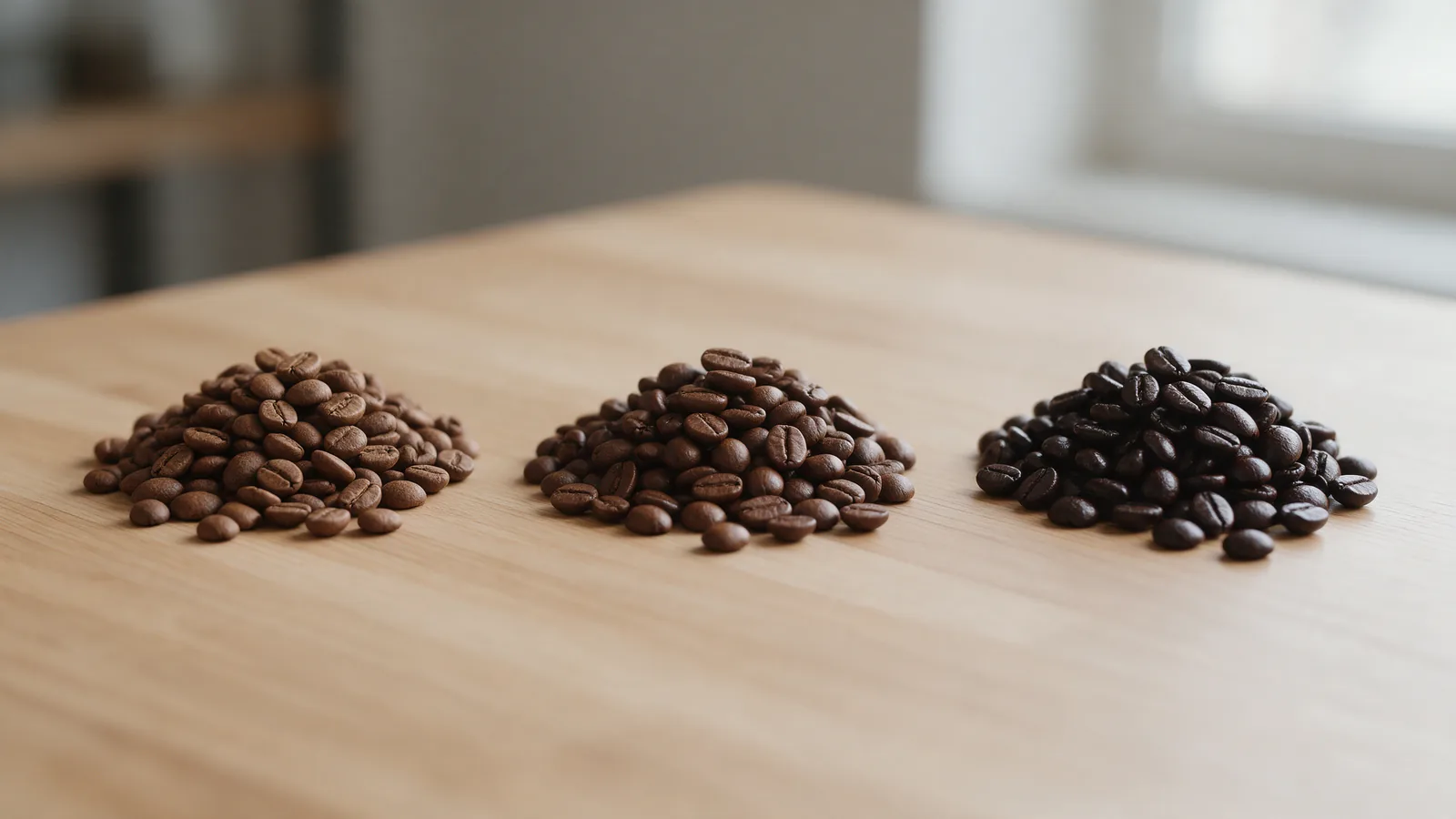
Light roast coffee is coffee whose beans are taken out of the roaster early, usually just after the “first crack” at roughly 196–205 °C (385–401 °F). The beans stay light brown and dry, keep more of their original acidity and fruity or floral flavours, and have a lighter body than medium or dark roasts. Contrary to popular belief, light roast does not have meaningfully more caffeine: per gram the difference between roasts is only a few percent. Below you will find what each roast level means, how they compare on flavour, acidity and body, which one suits your brewing method, and how to read the roast information on a bag.
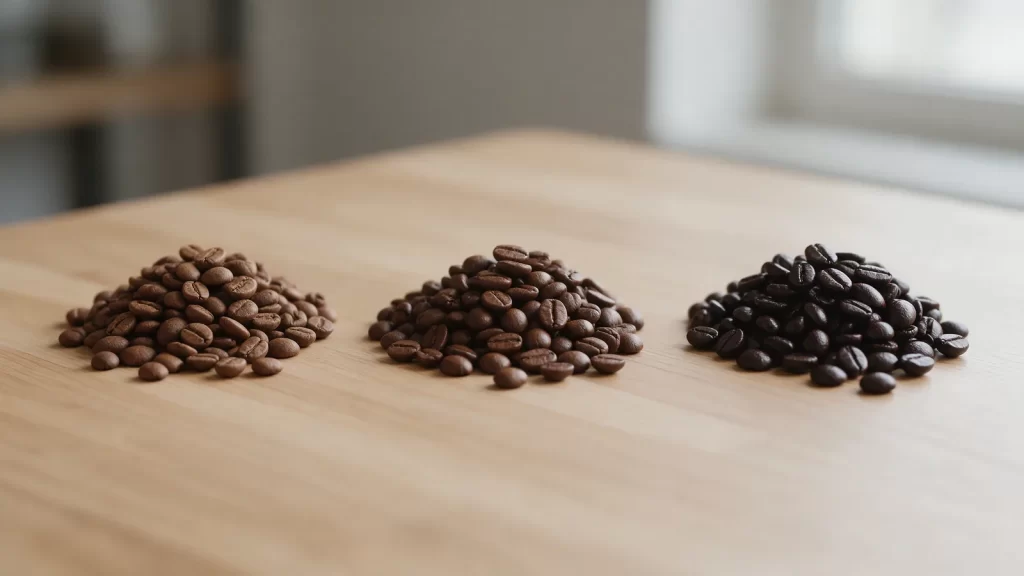
What is light roast coffee?
All coffee starts as a green seed. Roasting heats those seeds for roughly 8 to 15 minutes, and as the temperature climbs a series of chemical reactions (drying, the Maillard reaction, caramelisation) turns grassy green beans into the brown, aromatic coffee you grind at home. The longer and hotter the roast, the darker the bean and the more the roast itself shapes the flavour.
About 8–10 minutes into a typical roast the beans make an audible popping sound, a bit like popcorn. This is first crack: water vapour and CO₂ build pressure inside the bean until the cell structure fractures. A light roast is a roast that is stopped during or shortly after first crack. At that point the beans have:
- A light to cinnamon-brown colour and a matte, dry surface with no oil.
- Lost around 11–14% of their weight, mostly water.
- Kept most of their chlorogenic acids, fruit acids and delicate aromatics, which is why light roasts taste of the coffee’s origin rather than of the roast.
Specialty roasters favour light roasts for high-quality beans precisely because nothing hides: a washed Ethiopian can taste like bergamot and jasmine, a Kenyan like blackcurrant. That transparency cuts both ways. A cheap, defective coffee roasted light tastes sour and grassy, which is one reason big brands traditionally roast darker.
In my own kitchen in Galicia I learned this the hard way: the first light roast I bought went straight into the moka pot and tasted like lemon juice. The same bag, brewed as a slow pour-over with hotter water, was the best cup of the week. Roast level and brewing method go together, and we will get to that below.
The types of coffee roast
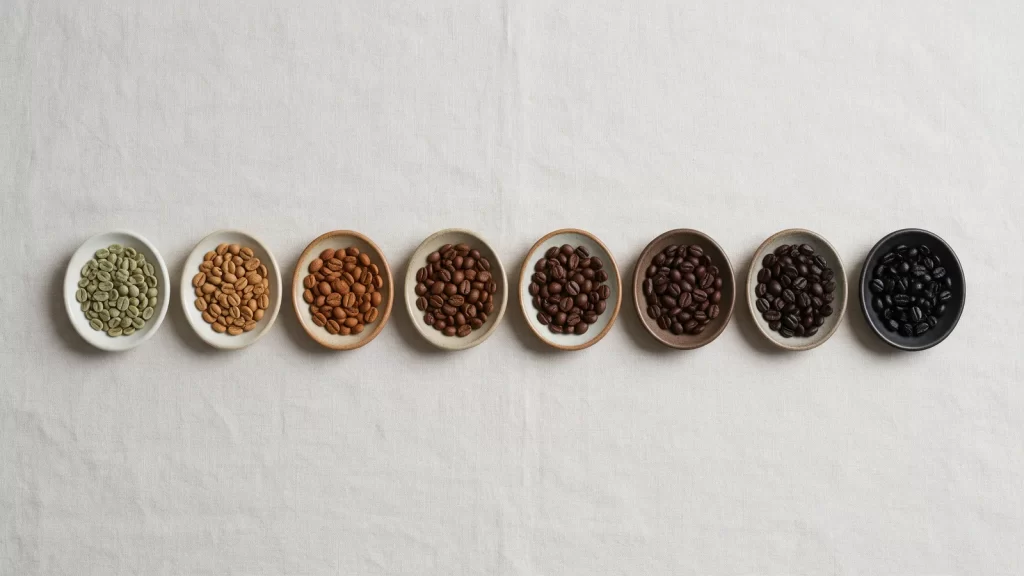
There is no legal standard for roast names, so one roaster’s “medium” can be another’s “light”. The most reliable reference points are the two cracks and the internal bean temperature. Professionals also measure colour with an Agtron or similar reflectance meter: the higher the number, the lighter the roast.
Light roast
Bean temperature: about 196–205 °C (385–401 °F), ending at or just after first crack. Common names: Light City, Half City, Cinnamon, New England, Nordic. Agtron: roughly 70–95.
Light brown, dry beans. The cup is bright and tea-like, with high perceived acidity, light body and floral, citrus or berry notes. Very light “Nordic” or “Scandinavian” roasts can be almost as pale as cinnamon and are designed for filter coffee only.
Medium roast
Bean temperature: about 210–220 °C (410–428 °F), well after first crack and before second. Common names: City, City+, American, Breakfast. Agtron: roughly 50–65.
Medium brown beans, still with a dry surface. This is the balance point: some origin character remains, but the roast adds caramel, nut and milk-chocolate notes and more body. Most supermarket “100% arabica” coffees sold in the US are medium roasts. If you are not sure what you like, start here.
A medium-dark roast (Full City, Full City+) is pulled just as second crack begins, around 225 °C (437 °F). Expect dark chocolate, a fuller body, a hint of bitterness and sometimes a few spots of oil.
Dark roast
Bean temperature: about 230–245 °C (446–473 °F), well into or past second crack, a quieter, faster crackling caused by the bean’s structure breaking down. Common names: Vienna, French, Italian, Spanish. Agtron: roughly 25–45.
Dark brown to almost black beans with an oily, shiny surface, and a weight loss of around 18–22%. The roast now dominates: smoky, bitter-sweet, roasted flavours with low acidity and a heavy body that cuts through milk. Origin differences mostly disappear. Past about 250 °C the beans start to taste burnt and ashy.
In Spain you will also find torrefacto coffee, roasted with added sugar that caramelises onto the bean. It is a regional style rather than a roast level, and we cover it in the Spanish version of this guide.
Flavour, acidity and body by roast
Here is how the three main roast levels compare in the cup. “Acidity” means perceived brightness on the tongue, not a dramatic difference in pH.
| Roast | Flavour notes | Acidity | Body | Bitterness | Bean surface |
|---|---|---|---|---|---|
| Light | Citrus, berries, stone fruit, florals, tea | High | Light | Low | Dry, matte |
| Medium | Caramel, nuts, milk chocolate, red apple | Medium | Medium | Low–medium | Dry |
| Medium-dark | Dark chocolate, molasses, spice | Medium–low | Full | Medium | Occasional oil spots |
| Dark | Smoke, roasted nuts, cocoa, burnt sugar | Low | Heavy | High | Oily, shiny |
Why does acidity drop as the roast gets darker? Green coffee is rich in chlorogenic acids, and heat breaks them down. Studies of roasting show that a dark roast can lose well over half of its chlorogenic acids compared with a light roast. Dark roasting also forms a compound called N-methylpyridinium (NMP), which a 2010 study in Molecular Nutrition & Food Research (Rubach et al.) linked to lower stomach acid secretion. That is one reason people with a sensitive stomach often tolerate dark roasts better, even though the pH of brewed coffee only ranges from about 4.8 to 5.1 across roasts.
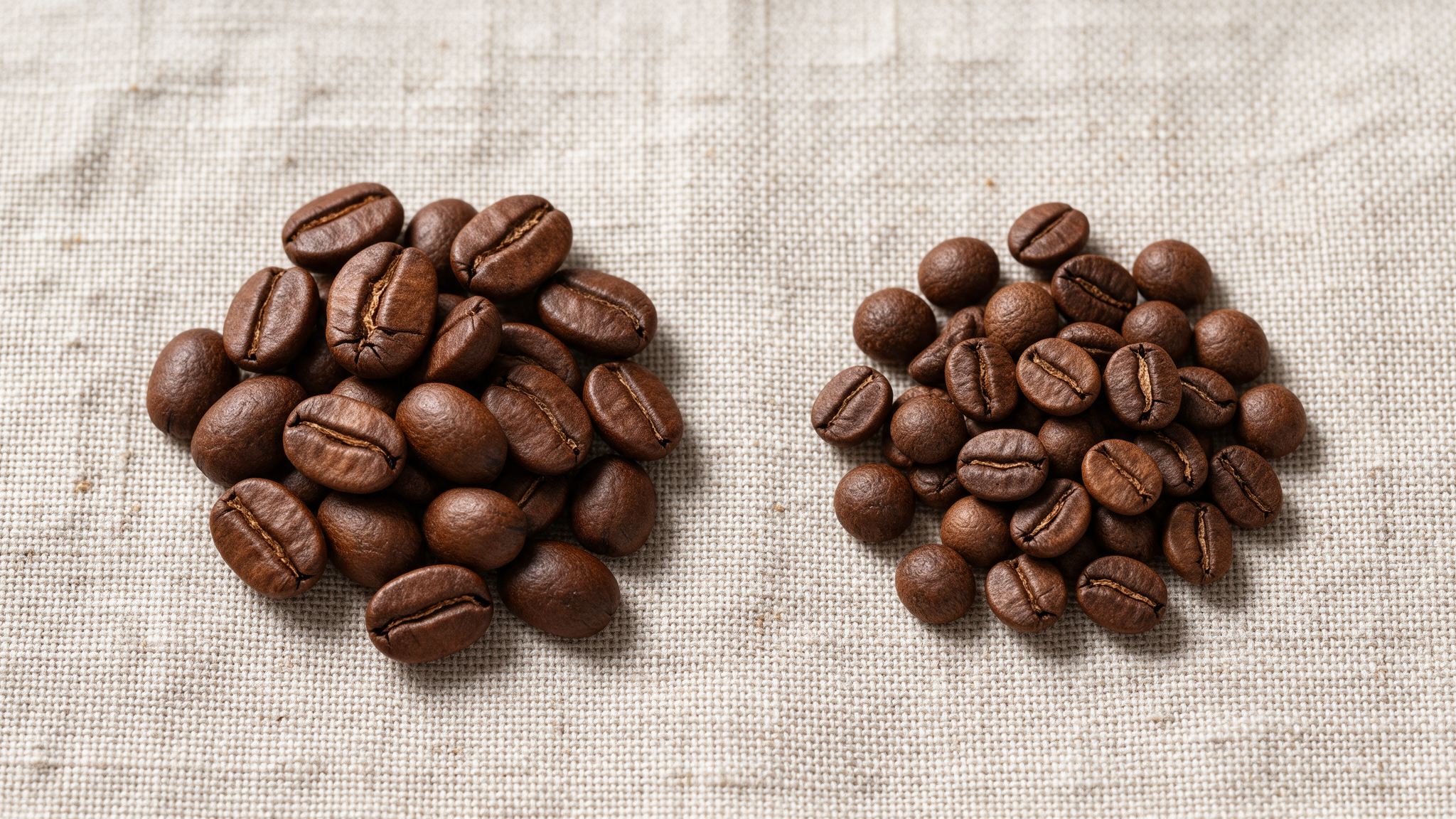
Origin matters too. Arabica beans grown at high altitude carry more acidity at any roast level than robusta, which is naturally more bitter and is almost always roasted dark. If you want the full comparison, see our guide to arabica vs robusta.
Which roast has more caffeine?
This is the most common myth about roast levels. Many people believe dark roast is “stronger” in caffeine because it tastes stronger; others have heard the opposite, that light roast has much more. The truth is in between and much less dramatic.
Caffeine is very heat-stable, so most of it survives roasting. A study of arabica and robusta at different roast degrees (Hečimović et al., Food Chemistry, 2011) found that caffeine content changed only slightly between light, medium and dark roasts. What does change is the bean’s mass and density:
- By weight, dark roast has slightly more caffeine per gram, because the bean has lost more water and other matter while keeping its caffeine.
- By volume (scoops or tablespoons), light roast has slightly more caffeine, because light beans are denser and a scoop holds more coffee.
In practice the difference is a few milligrams per cup. A typical 240 ml (8 oz) cup of brewed coffee contains around 80–100 mg of caffeine whatever the roast, and the species (robusta has roughly twice the caffeine of arabica), the dose and the brewing method matter far more. For reference, both the US FDA and the European Food Safety Authority (EFSA) consider up to 400 mg of caffeine a day safe for most healthy adults, and EFSA advises no more than 200 mg a day during pregnancy. Our guide on how much caffeine is in coffee breaks down the numbers by drink.
Which roast to choose for your brewing method
Roast level changes how easily coffee extracts. Light beans are harder and denser, so they need more energy (hotter water, a finer grind or more time) to extract properly. Dark beans are more porous and extract fast, so they turn bitter if you push them. These are the pairings that work best in my experience:
| Method | Best roast | Why |
|---|---|---|
| Pour-over (V60, Chemex) | Light to medium | Paper filters and clean extraction highlight fruit and florals. |
| AeroPress | Light to medium | Pressure and immersion handle dense light beans well. |
| Drip coffee maker | Medium | Many machines brew below 92 °C, which under-extracts light roasts. |
| French press | Medium to medium-dark | Full body and no paper filter suit chocolatey, rounder coffees. |
| Espresso (straight) | Medium to medium-dark | Easier to dial in, sweeter and less sour. |
| Espresso with milk | Medium-dark to dark | Roasty flavours cut through milk in lattes and cappuccinos. |
| Moka pot | Medium-dark to dark | Short, intense brew that makes light roasts taste sour. |
| Cold brew | Medium to dark | Cold water mutes acidity, so chocolatey roasts taste best. |
If you brew a light roast, use water just off the boil, around 94–96 °C, and a slightly longer contact time. For dark roasts, drop to 88–91 °C to avoid harshness. This is a reliable starting recipe for a light roast pour-over; the full technique is in our V60 pour-over guide:
Light roast pour-over (V60)
- Coffee
- 15 g, light roast
- Water
- 250 g filtered water
- Grind
- Medium-fine (like table salt)
- Water temp
- 94–96 °C
- Time
- 3:00–3:30 total
For cold brew, a medium roast at a 1:5 ratio gives a sweet, chocolatey concentrate; see how to make cold brew concentrate for the full method.
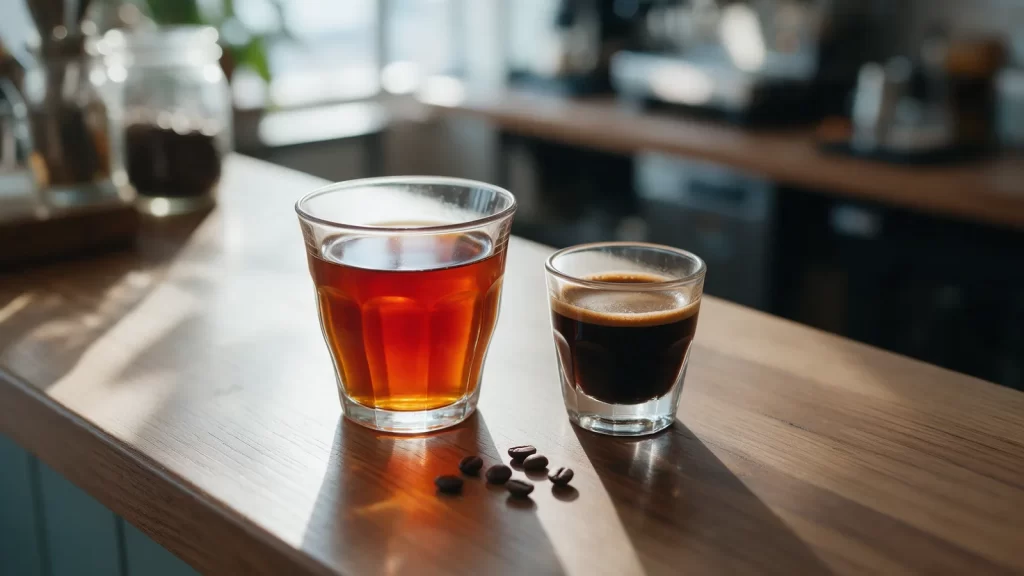
How to read the roast on a coffee bag
Because roast names are not standardised, the label tells you more than the word “light” or “dark” on its own. When you buy coffee, look for these details:
- Roast level or scale. Many roasters print a 1–5 bar or a short description. Use it to compare coffees from the same brand, not across brands.
- Roast date. More useful than a best-before date. Filter coffee tastes best roughly 5–30 days after roasting; light roasts for espresso often improve after resting 2–3 weeks. If there is no roast date, the coffee is probably not fresh.
- Tasting notes. Words like “lemon, jasmine, peach” signal a light roast; “caramel, hazelnut, cocoa” a medium; “dark chocolate, smoky, toasted” a dark roast.
- Intended method. “Filter roast” means light, made for pour-over and drip. “Espresso roast” is usually medium to dark. “Omni roast” is a middle-ground roast designed to work for both.
- Origin, process and variety. Washed coffees taste cleaner and brighter; natural (dry-processed) coffees fruitier and heavier. Single-origin coffees are more often roasted light; blends more often medium to dark.
- Bean appearance. If you buy whole beans, look: dry and light brown means light; even medium brown means medium; shiny with oil means dark.
Whatever roast you buy, store it in an airtight, opaque container away from heat and light, and grind just before brewing. Ground coffee loses aroma within minutes, and light roasts, whose appeal is all in those delicate aromatics, suffer the most.
FAQ
Does light roast have more caffeine?
Only slightly, and only when you measure by volume. A scoop of light roast holds a little more caffeine because light beans are denser. Measured by weight, dark roast has marginally more. Either way the difference is a few milligrams per cup, far less than the effect of the dose, the bean species or the brewing method.
Is light roast more acidic?
It tastes more acidic and contains more chlorogenic acids, which break down during longer roasts. The actual pH difference in the cup is small (about 4.8–5.1 for brewed coffee). If coffee bothers your stomach, a medium-dark or dark roast is usually gentler, partly because dark roasting forms N-methylpyridinium, a compound associated with lower stomach acid secretion.
Is blonde roast the same as light roast?
Roughly, but not exactly. “Blonde” is a marketing term, made popular by Starbucks for its lightest roasts (Veranda Blend and Blonde Espresso). It is light compared with the rest of the Starbucks range, which is roasted quite dark, but most specialty light roasts are lighter still. Think of blonde as a light-medium roast.
Which roast is best for espresso?
For most home baristas, a medium to medium-dark roast. It extracts easily, tastes sweet and balanced, and holds up in milk drinks. Light roast espresso can be excellent, with fruity, juicy shots, but it needs a finer grind, hotter water (93–96 °C) and often a longer ratio around 1:2.5; otherwise it tastes sour. Dark roasts make a classic, intense Italian-style shot but can turn bitter quickly.
Is light roast coffee stronger?
Not in the sense most people mean. “Strong” usually describes how intense or bitter coffee tastes, and dark roasts taste stronger. Caffeine is nearly the same across roasts. If you want a stronger cup, use more coffee per millilitre of water rather than changing the roast.

About the author
Keep reading
Arabica vs Robusta: What Actually Changes in Your Cup
Almost every bag of coffee is arabica, robusta or a blend of the two. They are different species of the same plant, and the differences show up in…