How to Make Cold Brew Concentrate at Home (Ratio, Steep Time, Dilution)
The exact cold brew concentrate recipe: 1:4 to 1:5 ratio, 12–18 hour steep, double straining, how to dilute it and how long it keeps.
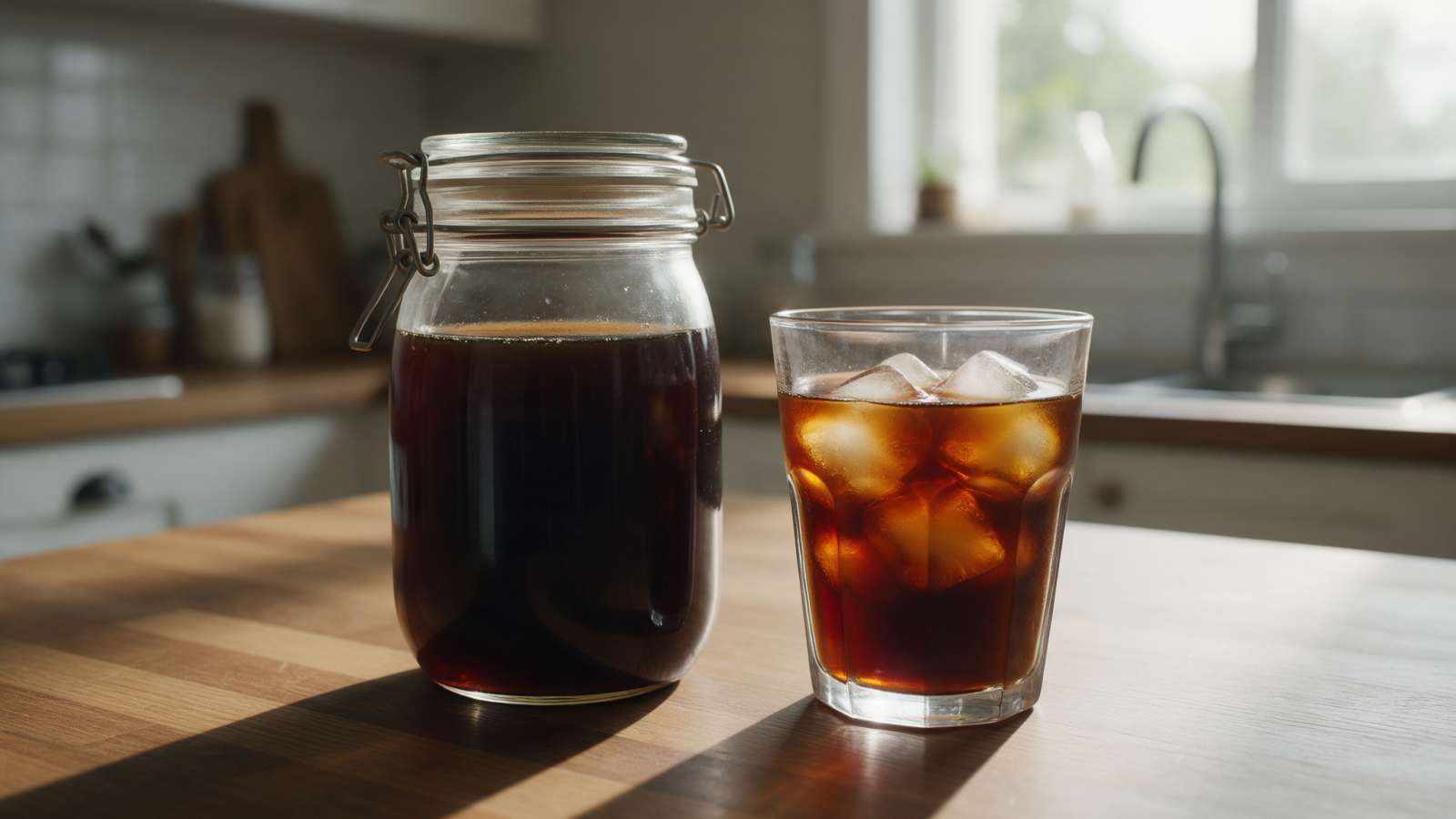
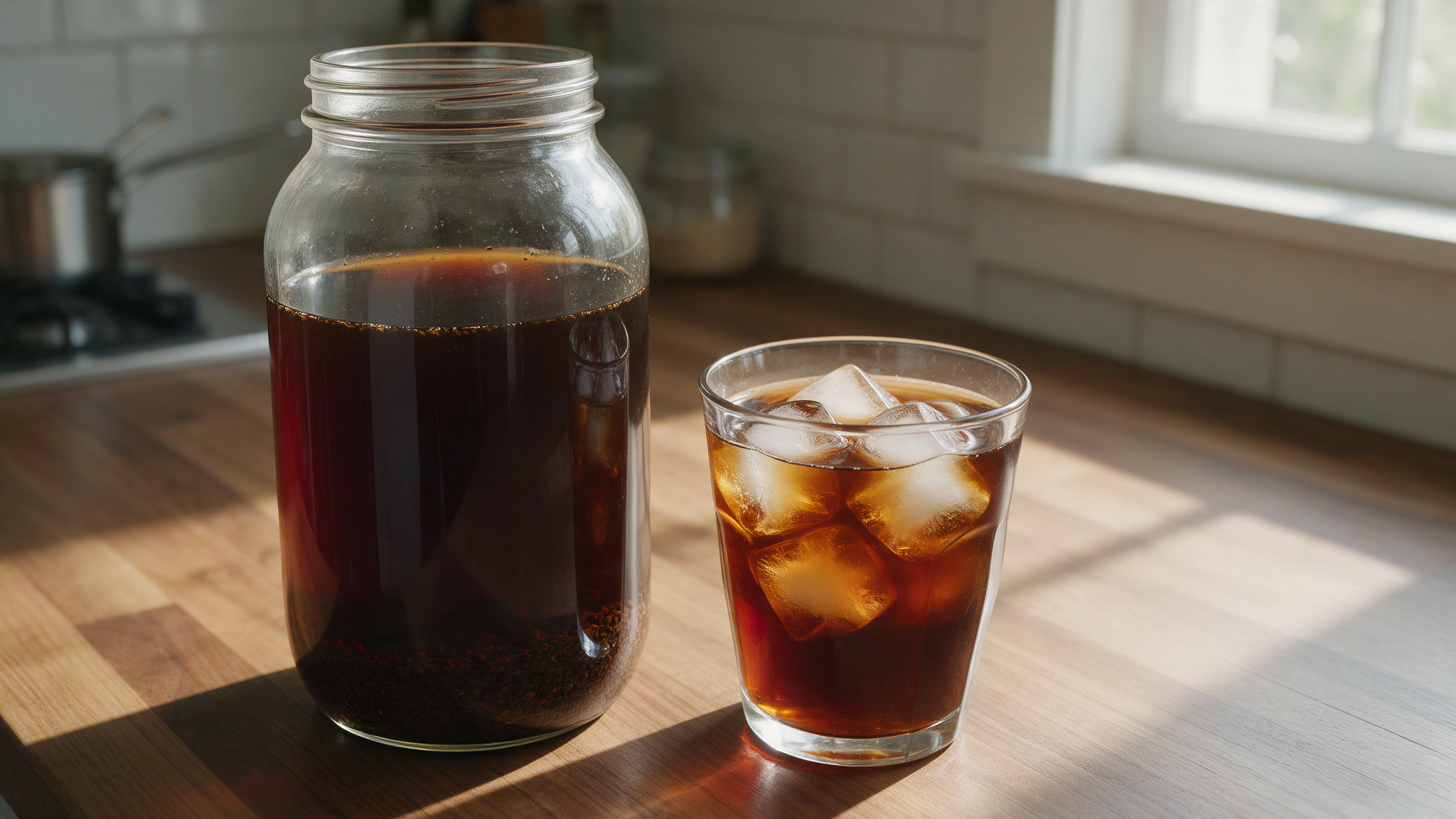
To make cold brew concentrate, stir coarsely ground coffee into cold filtered water at a ratio of about 1:4 to 1:5 by weight (for example 200 g of coffee to 800–1,000 g of water), cover it and let it steep for 12 to 18 hours, then strain it twice: once through a mesh sieve and once through a paper filter. Dilute it roughly 1:1 with water or milk, pour it over ice and you have smooth, low-bitterness coffee for the whole week. Below you will find the exact recipe, how to tweak the ratio and steep time, the mistakes that make cold brew bitter or watery, and how long it keeps.
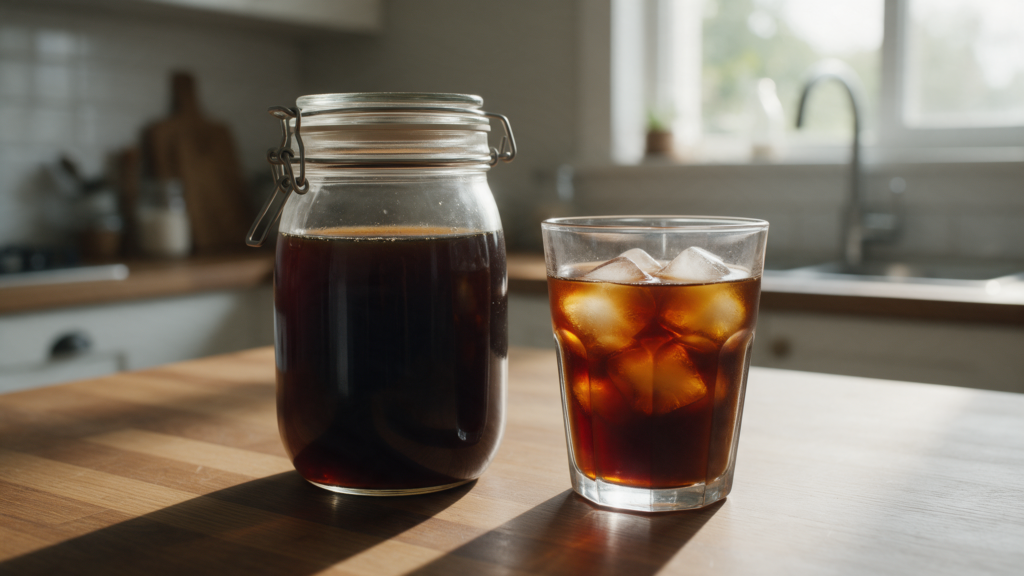
What is cold brew concentrate?
Cold brew is coffee extracted with cold or room-temperature water over many hours instead of hot water over a few minutes. Because the water is cold, it pulls out fewer of the bitter compounds and acids that hot water extracts quickly, so the result tastes rounder, sweeter and chocolatey, with less sharpness. Many people who find hot coffee harsh on the stomach tolerate cold brew better for that reason.
A concentrate is simply cold brew made with much more coffee per litre of water than you would actually drink. Instead of brewing at drinking strength (around 1:8 or weaker), you brew at 1:4 or 1:5 and then dilute each glass as you pour it. There are three good reasons to brew it this way:
- It saves fridge space. One litre of concentrate becomes two to three litres of drinkable coffee.
- It keeps better. A stronger brew holds its flavour longer than a diluted one.
- It is flexible. The same jar can make a black iced coffee, an iced latte, a cocktail base or a hot cup.
Cold brew is not the same as iced coffee. Iced coffee is hot coffee cooled down or brewed directly onto ice, and it keeps the brighter acidity of hot extraction. Cold brew never touches hot water at all.
What you need to make cold brew concentrate
You do not need special gear. A big jar and a way to strain it are enough. If you own a French press you already have a complete cold brew maker, and we cover that method in its own guide.
- A container of 1–2 litres with a lid: a mason jar, a jug or a French press.
- A kitchen scale. Volumes of ground coffee vary a lot with the grind, so weighing gives repeatable results.
- A fine mesh sieve plus a paper coffee filter, a nut-milk bag or a clean cotton cloth.
- A clean bottle or jar to store the finished concentrate.
Coffee: which beans work best
Medium and medium-dark roasts are the classic choice. Cold extraction mutes acidity, so the chocolate, nutty and caramel notes of these roasts come through clearly. Light roasts work too, but they can taste thin or tea-like unless you steep them toward the long end of the range. Whatever you choose, freshness matters more than origin: beans roasted within the last two to six weeks give a noticeably livelier brew than an old bag.
Grind: coarse, like rough sea salt
Grind size is the setting that most often goes wrong. Aim for a coarse, even grind similar to what you would use for a French press, with particles around 1–1.5 mm. Fine coffee extracts too fast over a long steep, tastes muddy and bitter, and turns straining into a slow, silty mess.
Can you use regular pre-ground coffee? Yes. Supermarket ground coffee is usually ground for drip machines, which is finer than ideal, but it still makes perfectly drinkable cold brew. Shorten the steep to 12–14 hours to avoid bitterness and strain it through a paper filter to catch the fines. If you buy beans, ask the shop to grind them “for French press” or “for cold brew”.
Water: filtered and cold
Coffee is more than 98% water, so its taste shows. Use filtered or good-tasting tap water at fridge or room temperature. Very hard water flattens flavour; distilled water makes a hollow brew because some minerals help extraction.
How to make cold brew concentrate: step-by-step recipe
Cold brew concentrate (immersion)
- Coffee
- 200 g, medium roast
- Water
- 1,000 g (1 L) filtered water
- Grind
- Coarse (French press)
- Water temp
- Room temp or fridge (4–20 °C)
- Time
- 12–18 h room temp / 18–24 h fridge
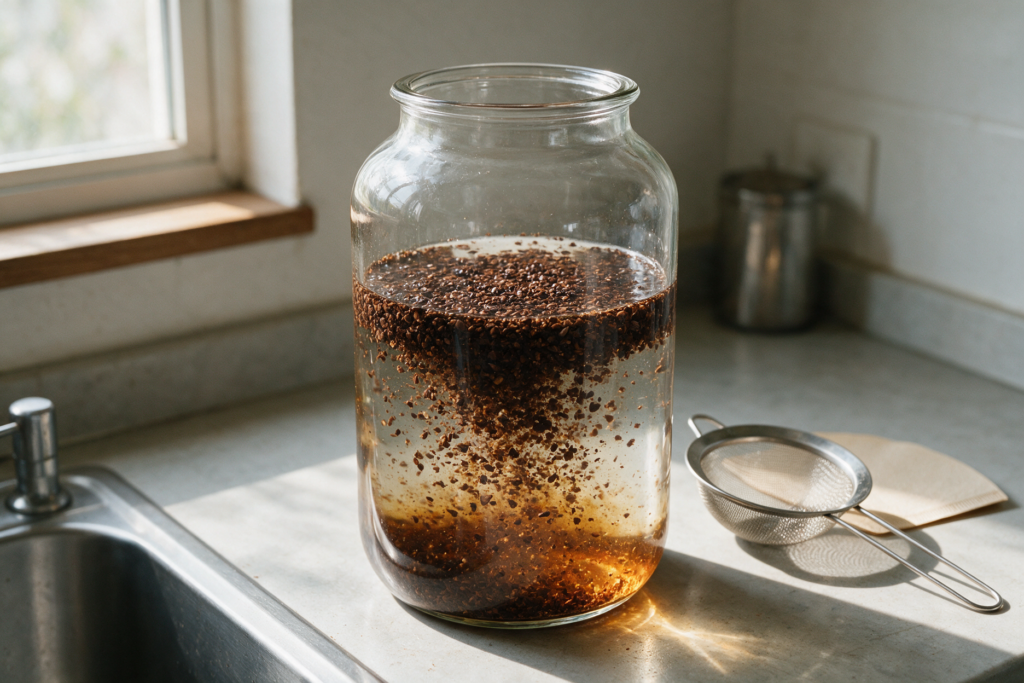
- Weigh and grind. Weigh 200 g of coffee and grind it coarse. This makes about 750–800 ml of concentrate, since the grounds hold on to roughly twice their weight in water.
- Wet the grounds. Put the coffee in the jar and pour in about a quarter of the water. Stir for 10–15 seconds so every particle is wet, with no dry clumps.
- Add the rest of the water. Pour in the remaining water and stir gently once more. Push down any grounds floating on top.
- Cover and steep. Close the jar and leave it on the counter away from direct sun for 12–18 hours, or in the fridge for 18–24 hours.
- First strain. Pour through a fine mesh sieve into a clean jug. Do not press or squeeze the grounds; that pushes bitter fines and sludge into the coffee.
- Second strain. Pour the liquid again through a paper filter (a pour-over cone or a filter set in the sieve works). This takes 5–15 minutes but gives a clean, sediment-free concentrate that lasts longer.
- Bottle and chill. Transfer to a clean, airtight bottle and refrigerate.
Ratio: from 1:4 to 1:8
Cold brew ratios are expressed as coffee to water by weight. A lower second number means a stronger brew. Here is how the common ratios behave:
| Ratio | Coffee for 1 L of water | Result | How to serve |
|---|---|---|---|
| 1:4 | 250 g | Very strong concentrate, almost syrupy | Dilute 1:2 to 1:3 |
| 1:5 | 200 g | Balanced everyday concentrate | Dilute 1:1 to 1:2 |
| 1:6 | 165 g | Light concentrate | Dilute 1:1 or drink with milk |
| 1:8 | 125 g | Ready-to-drink cold brew | Pour straight over ice |
If you measure with scoops, 1 cup of whole beans weighs roughly 85–95 g, and 1 cup of coarse ground coffee about 80–90 g. So the popular “1 cup of grounds to 4 cups of water” recipe lands close to 1:11 by weight once you account for the water’s 236 g per cup, which is why it gives a drinkable brew rather than a true concentrate. For the full breakdown by volume and batch size, see our cold brew ratio guide.
Steep time: 12 to 24 hours
Time and temperature work together. At room temperature (about 20 °C) extraction is faster, so 12–18 hours is the sweet spot. In the fridge (around 4 °C) it slows down, and 18–24 hours gives a similar strength. Start at 15 hours on the counter and adjust:
- Under 12 hours: thin, sour or grassy. The sugars and body have not come out yet.
- 12–18 hours: full, sweet, chocolatey.
- Over 24 hours: woody, dry and flat. Longer steeping does not make it much stronger; it mostly adds harsh flavours.
Use the ratio to control strength and the steep time to control flavour. If your cold brew tastes good but weak, use more coffee next time rather than steeping longer.
Filtering without sediment
Sediment is what makes cold brew taste muddy after a couple of days in the fridge. A two-stage strain fixes it: a sieve for the bulk of the grounds, then a paper filter for the fines. A cotton or nut-milk bag inside the jar from the start makes the first step easier: lift it out, let it drip for a minute and move on to the paper filter. Let the liquid drain by gravity rather than squeezing.
How to dilute and serve cold brew concentrate
Concentrate is not meant to be drunk straight. Start with these proportions, taste and adjust:
- Black iced coffee: 1 part concentrate to 1 part cold water, over a full glass of ice. Use 1:2 if you made a 1:4 concentrate.
- Iced latte: 1 part concentrate to 1–2 parts cold milk or oat milk. Our iced latte guide covers milk choices and sweeteners.
- Hot cold brew: 1 part concentrate to 1 part just-boiled water. It is gentler than a regular hot coffee and ready in seconds.
A typical serving is 60–120 ml of concentrate. Ice melts as you drink, so if you like a stronger glass, dilute a little less or freeze some cold brew into ice cubes.
How strong is it? Caffeine in cold brew concentrate
Caffeine depends on the beans, the ratio and the steep time, so any number is an estimate. A 1:4 or 1:5 concentrate typically contains on the order of 50–100 mg of caffeine per 60 ml, which drops to a regular coffee’s range once diluted. For comparison, a single 30 ml shot of espresso has about 63 mg according to USDA data, and an 8 oz (240 ml) cup of brewed coffee about 95 mg. The US FDA considers up to 400 mg a day generally safe for most healthy adults, so two generous glasses of diluted cold brew are well within that. For more on how different drinks compare, see how much caffeine is in coffee.
Is cold brew concentrate stronger than espresso? Per millilitre, usually not: espresso extracts more caffeine per ml in its 25–30 second shot. But nobody drinks 30 ml of cold brew. A 120 ml pour of concentrate can easily carry more caffeine than a double espresso, which is why it is worth measuring rather than free-pouring.
Common mistakes (bitter or watery cold brew)
| Problem | Likely cause | Fix |
|---|---|---|
| Bitter, harsh | Grind too fine, steeped over 24 h, grounds squeezed | Grind coarser, cut the steep to 15 h, strain by gravity |
| Watery, weak | Ratio too weak, over-diluted, too much ice | Use 1:5 or 1:4, dilute 1:1, use coffee ice cubes |
| Sour, grassy | Steep too short, very light roast, fridge steep cut short | Steep longer (18 h+ in the fridge) or switch to a medium roast |
| Muddy, gritty | Fines in the brew | Add a second strain through a paper filter |
| Stale or flat after a few days | Old beans, jar not sealed, already diluted | Use fresh beans, store airtight, dilute only per glass |
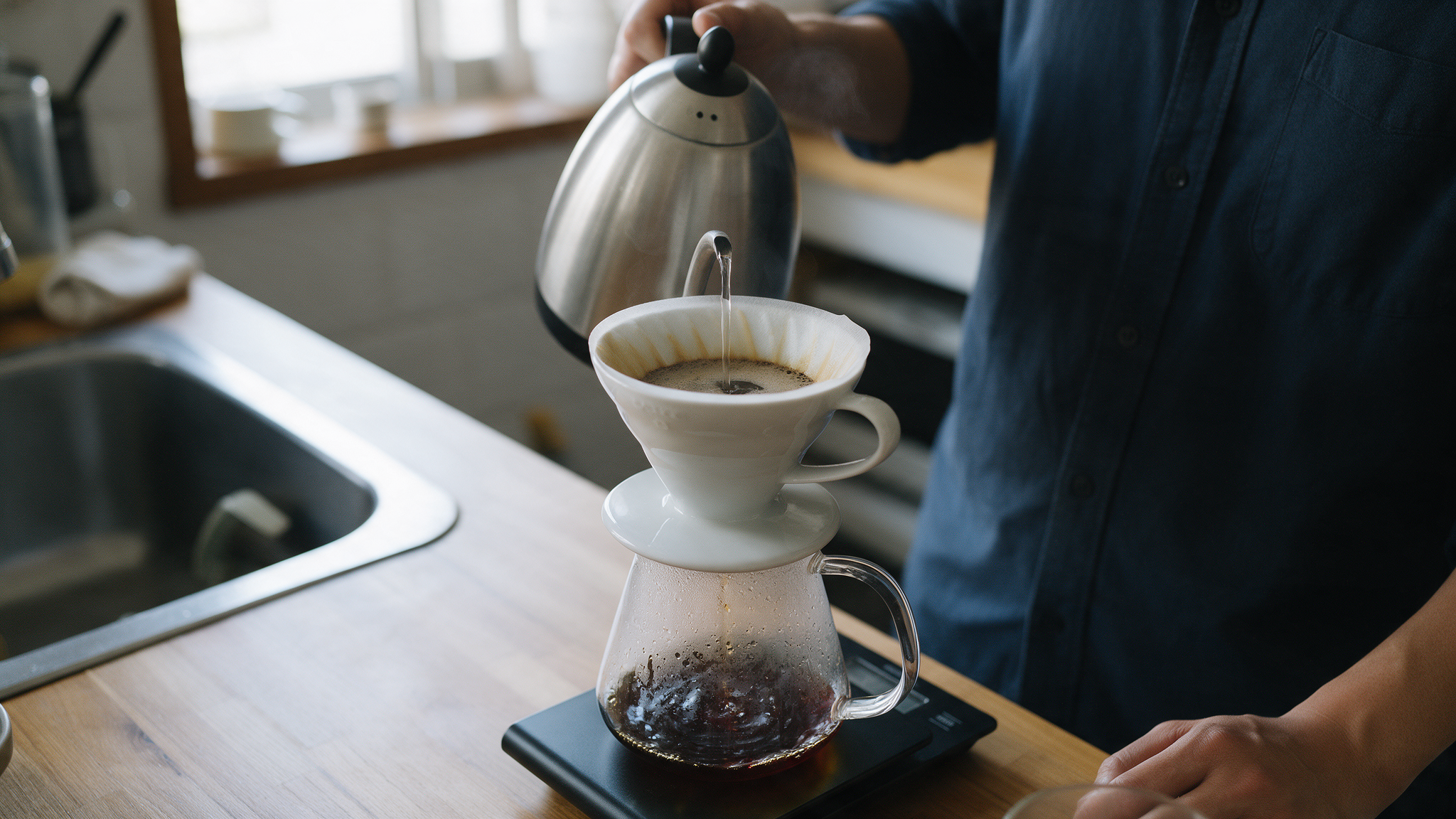
One mistake deserves its own mention: hot water. Some recipes “bloom” the grounds with a splash of hot water to speed things up. That works, but it brings back some of the acidity and bitterness cold brew is supposed to avoid. If you are in a hurry, an iced pour-over made with a V60 is a better shortcut.
How long does cold brew concentrate last in the fridge?
Stored in a clean, airtight glass bottle in the fridge at 4 °C or below, undiluted concentrate stays good for about 7 to 10 days, and tastes best in the first week. Once you dilute it with water, drink it within 2–3 days; mixed with milk, within 24 hours. Leaving out the paper-filter step shortens its life because the fines keep extracting in the bottle.
Signs it has gone off: a sour or fermented smell, a sharp vinegary taste or any film or mould on the surface. Throw it out. Because cold brew is never heated, it does not get the small safety margin hot brewing gives, so clean jars and steady refrigeration matter. Do not leave a finished batch at room temperature for hours.
You can also freeze cold brew concentrate in ice-cube trays for up to about three months. The cubes chill your next glass without watering it down.
Variations: milk, spices and homemade nitro
- Vanilla or caramel: add 10–15 ml of syrup per glass, or split a vanilla pod into the jar while it steeps.
- Spiced cold brew: add one cinnamon stick, 3–4 crushed cardamom pods or a strip of orange peel per litre to the grounds before steeping.
- Sweet cream cold brew: whisk 2 parts double cream, 1 part milk and a little vanilla syrup, then float it on top of a glass of diluted concentrate.
- Mexican-style: steep with a cinnamon stick and a little piloncillo or brown sugar.
- Homemade “nitro”: true nitro cold brew is infused with nitrogen from a keg, which gives it a creamy, Guinness-like head. At home, a cream whipper charged with a nitrous oxide (N2O) cartridge gets you surprisingly close: fill it halfway with diluted cold brew, charge, shake and dispense into a glass with no ice.
FAQ
What is the ratio for cold brew concentrate?
The standard ratio is 1:4 to 1:5 coffee to water by weight, for example 200–250 g of coarse ground coffee per litre of water. For ready-to-drink cold brew that needs no dilution, use about 1:8.
How long should cold brew steep?
Steep it 12–18 hours at room temperature or 18–24 hours in the fridge. Around 15 hours on the counter is a good starting point. Avoid going past 24 hours, which adds bitter, woody flavours without much extra strength.
Can you use regular ground coffee for cold brew?
Yes. Regular pre-ground coffee is finer than ideal, so steep it for 12–14 hours instead of 18 and strain it through a paper filter to remove the fine particles. The result is a little less clean than with a coarse grind but still very good.
Is cold brew concentrate stronger than espresso?
Per millilitre, espresso is usually stronger: about 63 mg of caffeine in a 30 ml shot. Cold brew concentrate is typically a bit less concentrated, but because it is served in much larger amounts, a glass made from 120 ml of concentrate can contain more caffeine than a double espresso.
Should cold brew steep in the fridge or on the counter?
Both work. Counter steeping is faster and gives a slightly fuller body; fridge steeping is slower, a little cleaner and convenient if you want to start it and forget it. Either way, move the finished concentrate to the fridge as soon as you strain it.

About the author
Keep reading
How Much Coffee Per Cup? Scoops, Tablespoons and Grams (Chart)
How much coffee per cup: 15 g per 8 oz (about 3 tablespoons) at a 1:16 ratio. Chart for 1–12 cups and the right ratio for every brewing method.
Cold Brew Ratio: How Much Coffee per Cup of Water
Start at 1:5 for concentrate or 1:8 to drink straight, steep for 16 hours, and adjust from there. Here is why those numbers work.
How to Brew a V60: A Simple Pour-Over Recipe
The V60 rewards a little attention with a clean, bright cup. This recipe keeps the steps few and the numbers fixed, so the only thing you need to…