What Is Nitro Cold Brew? Taste, Caffeine and How It’s Made
What is nitro cold brew? Cold brew charged with nitrogen and poured from a tap: creamy, no dairy, about 265 mg caffeine per 16 oz. How to make it at home.
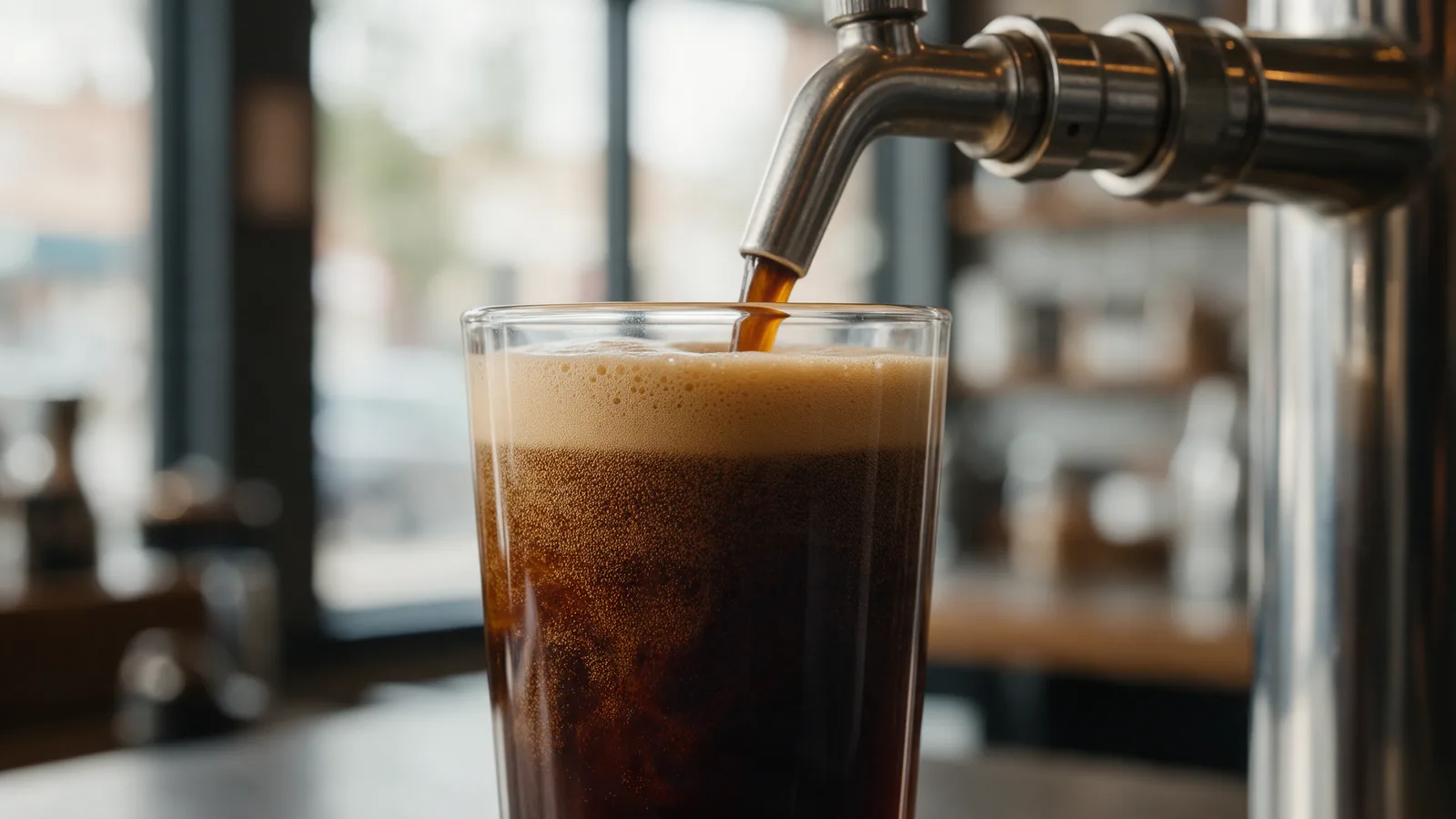
What is nitro cold brew? It is cold brew coffee infused with nitrogen gas and poured from a pressurised tap, the same way a stout beer is served. The nitrogen forms millions of tiny bubbles that cascade down the glass and settle into a thick, creamy head, giving the coffee a silky, almost milky texture without any milk or sugar. Nitro cold brew tastes smoother and slightly sweeter than regular cold brew, has the same caffeine per millilitre (a 16 oz Starbucks grande has about 265 mg because it is served without ice) and almost no calories when black. You can make a close version at home with a cream whipper.

What is nitro cold brew (and what is nitro coffee)?
Nitro coffee is any coffee infused with nitrogen, but in practice it almost always means nitro cold brew: coffee steeped in cold water for 12 to 24 hours, filtered, chilled, then pressurised with nitrogen in a keg. When it is poured through a special tap, the gas comes out of solution as microbubbles, producing the cascading “Guinness effect” and a foamy cap a centimetre or two thick.
The idea came from craft beer. Third-wave cafés in the United States started putting cold brew on nitro taps in the early 2010s, ready-to-drink cans followed, and Starbucks rolled Nitro Cold Brew out to its stores from 2016. In our guide to the types of coffee drinks it sits in the cold coffee family, next to cold brew, iced coffee and the iced latte.
How nitro cold brew is made: nitrogen, tap and siphon
A café makes nitro cold brew in four steps:
- Brew the cold brew. Usually at a ready-to-drink strength of about 1:8 to 1:10 (100–125 g of coarse coffee per litre of water), steeped 12–20 hours in the fridge or at room temperature and filtered well. Fine sediment would ruin the foam, so filtering matters more than usual.
- Keg it. The coffee goes into a stainless steel keg, often a 19 litre (5 gallon) “corny” keg, kept at 2–4 °C.
- Charge it with nitrogen. Pure nitrogen (N₂) or a nitrogen-rich “beer gas” (around 70% N₂, 30% CO₂) is pushed into the keg at about 30–45 psi (2–3 bar).
- Pour it through a stout faucet. The faucet has a small restrictor plate with tiny holes. Forcing the coffee through it at pressure knocks the dissolved nitrogen out as microbubbles. That is the cascade you see in the glass for the first 30–60 seconds.
Why nitrogen and not CO₂? Nitrogen is roughly 50 to 100 times less soluble in water than carbon dioxide, so it forms very small bubbles that stay suspended and feel creamy rather than prickly. CO₂ also reacts with water to form carbonic acid, which is why soda tastes sharp. Put CO₂ in coffee and you get a fizzy, sour drink (sparkling coffee is a thing, but it is not nitro).
Can you make nitro cold brew at home?
Yes, at three levels of effort.
1. Cream whipper (siphon), the easy way. A standard 0.5 or 1 litre whipped-cream siphon works with nitrous oxide (N₂O) chargers, not pure nitrogen. N₂O is more soluble and slightly sweet, so the result is a little foamier and sweeter than true nitro, but the cascade and creamy head are very close.
Nitro-style cold brew (cream siphon)
- Coffee
- 500 ml chilled cold brew (1:8)
- Water
- Already in the cold brew
- Grind
- Coarse (for the cold brew)
- Water temp
- 2–4 °C
- Time
- 30 s shake + 2 min rest
- Make or dilute your cold brew to drinking strength. Our cold brew concentrate recipe diluted 1:1 with water works well, or brew directly at 1:8 using the cold brew ratio guide.
- Filter it twice, through a paper filter the second time. Any fines will clog the siphon nozzle.
- Chill it to fridge temperature. Cold liquid holds more gas and foams better.
- Fill the siphon no more than halfway to two-thirds (500 ml in a 1 litre siphon), screw on the head and charge with one N₂O cartridge (two for a 1 litre siphon).
- Shake hard for about 30 seconds, then let it rest for 1–2 minutes in the fridge.
- Hold the siphon upside down and dispense against the side of a tall glass, without ice. Wait 30 seconds for the cascade to settle.
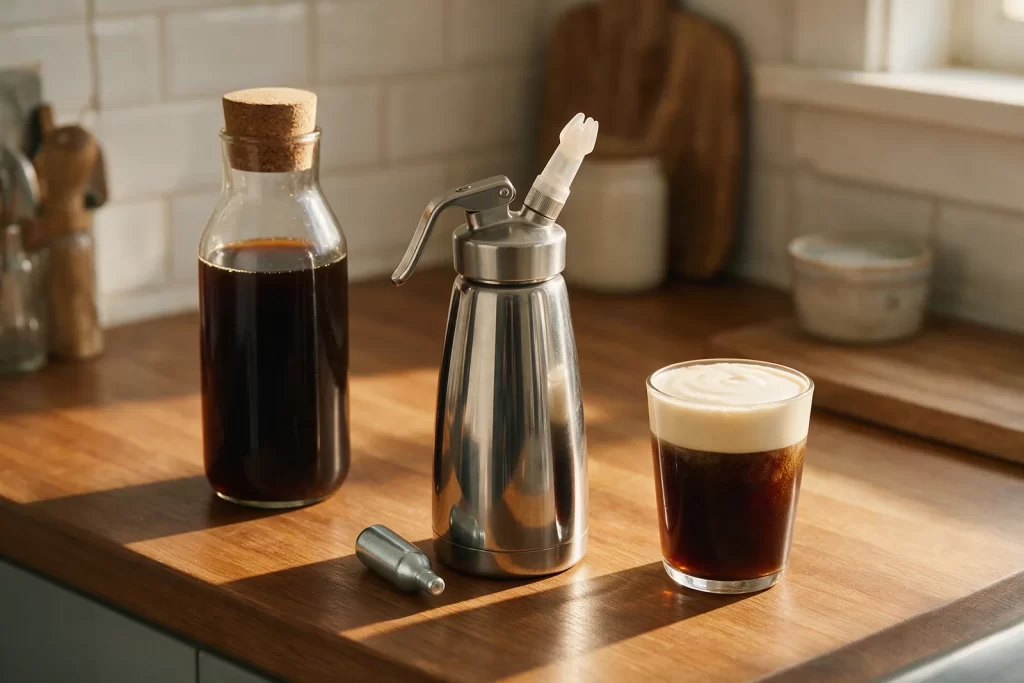
2. Nitro cold brew maker. Countertop “nitro coffee makers” and mini kegs (1–2 litres) use small pure-nitrogen cartridges and a built-in stout tap. They give a pour very close to a café’s.
3. A home kegerator. A corny keg, a nitrogen cylinder with a regulator and a stout faucet: the most expensive option, worth it only if you drink nitro every day.
Nitro cold brew taste and texture vs regular cold brew
Same coffee, very different experience. Here is what changes when you add nitrogen:
- Texture: the microbubbles give a dense, velvety body and a creamy head, a bit like a stout or a flat white.
- Perceived sweetness: nitro tastes sweeter even though it contains no added sugar. The creamy mouthfeel and the aroma released by the foam soften bitterness, and our brains read that as sweetness.
- Acidity: cold brew is already gentle on acidity. Nitro softens it further, while CO₂ would sharpen it.
- Temperature: it is served cold, at about 3–5 °C, but without ice, so it does not get watered down as you drink it.
The trade-off: the head collapses after 10–15 minutes and the drink becomes ordinary cold brew, so drink it soon after pouring.
Nitro cold brew caffeine and calories
Nitrogen is an inert gas. It adds no caffeine, no calories and no flavour of its own. A nitro cold brew has the same caffeine per millilitre as the cold brew in the keg, which for ready-to-drink cold brew is roughly 0.5–0.8 mg per ml.
So why do chains list more caffeine for nitro? Because of ice. A grande (16 oz) Starbucks Cold Brew is poured over ice, so a good part of the cup is frozen water. A grande Nitro Cold Brew is served without ice and the cup is nearly all coffee. According to Starbucks’ published nutrition information, that gives about 265 mg of caffeine for a grande Nitro Cold Brew against about 205 mg for a grande Cold Brew.
For context, 265 mg is two-thirds of the 400 mg a day that the US FDA and the European Food Safety Authority (EFSA) consider safe for most healthy adults, and above EFSA’s 200 mg limit for a single dose and for a whole day during pregnancy. Our article on whether cold brew has more caffeine compares it with drip coffee and espresso, and our caffeine in coffee guide has the full list of drinks.
Calories are almost zero: black coffee has about 2 kcal per 240 ml according to USDA data, and Starbucks lists 5 kcal for a grande Nitro Cold Brew. The numbers only climb with additions: a vanilla sweet cream nitro is around 70–100 kcal, depending on size.
Nitro vs cold brew vs iced coffee
The three are often confused on menus; the difference is how they are brewed and served.

| Nitro cold brew | Cold brew | Iced coffee | |
|---|---|---|---|
| Brewing | Cold steep 12–24 h, then nitrogen | Cold steep 12–24 h | Brewed hot, then cooled or poured over ice |
| Served | From a tap, no ice | Over ice | Over ice |
| Texture | Creamy, foamy head | Smooth, still | Light, thinner |
| Flavour | Sweet-tasting, low bitterness | Chocolatey, low acidity | Brighter, more acidic, can taste flat |
| Caffeine (16 oz, Starbucks) | About 265 mg | About 205 mg | About 165 mg |
| Prep time | Overnight + keg | Overnight | 5 minutes |
If you want the creamiest black coffee, choose nitro. If you want something you can make in bulk and keep in the fridge, cold brew. If you want a cold coffee right now, iced coffee or an iced latte.
FAQ
Is nitro cold brew stronger?
Per millilitre, no: it is the same coffee as regular cold brew, and nitrogen adds no caffeine. Per cup, usually yes, because it is served without ice, so more of the cup is coffee. A grande Starbucks Nitro Cold Brew has about 265 mg of caffeine vs about 205 mg for a grande Cold Brew. It can also taste less strong than it is, because the creamy texture hides bitterness.
Does nitro cold brew have dairy?
No. Plain nitro cold brew is just coffee, water and nitrogen; the creamy look and feel come entirely from the gas bubbles. That makes it a good option if you are lactose intolerant or vegan. Flavoured versions such as sweet cream nitro do contain dairy, so check the menu or the can label.
Why is nitro cold brew served without ice?
Ice breaks the cascade and flattens the foamy head, because the bubbles burst against the cubes and the melting water dilutes the drink. The coffee is already kept at 2–4 °C in the keg, so it does not need ice to be cold. If you prefer it icier, chill the glass in the freezer instead.
Sources
- Starbucks published nutrition information (Nitro Cold Brew, Cold Brew, Iced Coffee, grande 16 oz).
- USDA FoodData Central: coffee, brewed from grounds.
- US FDA: “Spilling the Beans: How Much Caffeine Is Too Much?”.
- EFSA (2015): Scientific Opinion on the safety of caffeine.
- Sander R. (2015). “Compilation of Henry’s law constants for water as solvent”. Atmospheric Chemistry and Physics 15, 4399–4981 (solubility of N₂ and CO₂).

About the author
Keep reading
How Long Does Cold Brew Last in the Fridge? (And Can You Heat It Up?)
Cold brew concentrate lasts up to 2 weeks in the fridge, diluted 3–4 days, with milk 1–2. Signs it's gone bad, storage tips and how to heat it up.

Does Cold Brew Have More Caffeine Than Regular Coffee?
Does cold brew have more caffeine? Usually: 150–250 mg per 12 oz glass vs about 140 mg for drip. Why it varies, a table vs espresso and how to cut it.
French Press Coffee Ratio: How Much Coffee to Use (Chart)
The best French press coffee ratio is 1:15: 30 g of coarse coffee for 450 ml of water. Chart by press size, grind, steps and fixes for bitter cups.