Types of Coffee Drinks: 20 Drinks Explained (With Ratios)
The 20 types of coffee drinks explained: espresso, cortado, cappuccino, latte, flat white, cold brew and more, with ratios, sizes and caffeine.
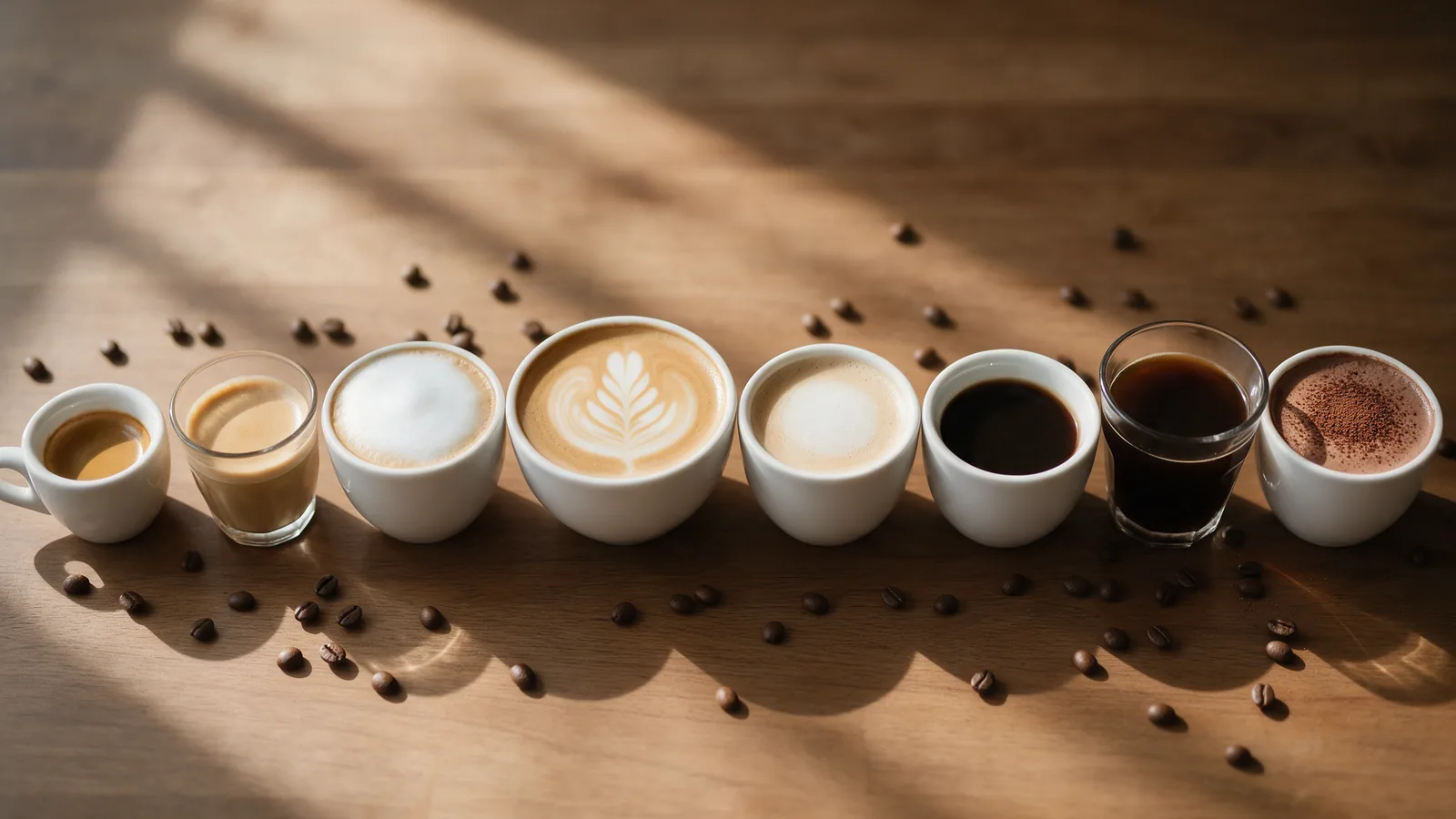
There are dozens of types of coffee drinks, but almost all of them are built from the same few ingredients: espresso or brewed coffee, water, milk and milk foam. What changes is the proportion. An espresso is about 30 ml of concentrated coffee; add hot water and it becomes an americano; add an equal amount of steamed milk and it is a cortado; add a lot more milk and a thin layer of foam and it is a latte. Below are the 20 coffee drinks you are most likely to meet in a café or make at home, each with its ratio, cup size, typical caffeine and taste, plus a one-table cheat sheet at the end.
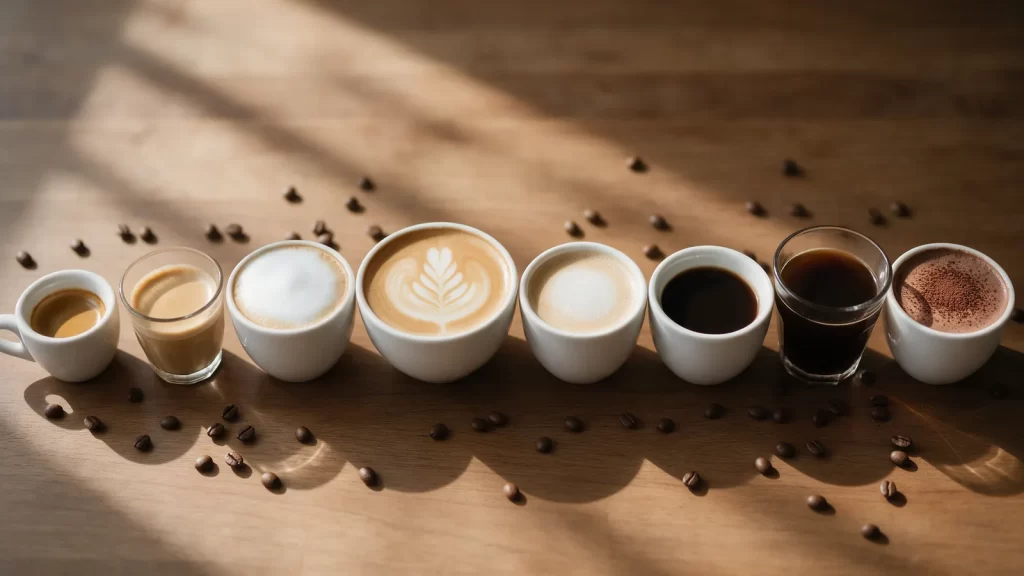
Types of coffee drinks at a glance
Before we go drink by drink, it helps to know the three families every coffee belongs to:
- Espresso-based drinks. Coffee forced through finely ground beans at about 9 bar of pressure for 25 to 30 seconds. Everything from the americano to the mocha starts here.
- Brewed or filter coffee. Hot water meets coarser coffee without pressure: drip machines, pour-over cones, the French press and the stovetop moka pot (which uses a little steam pressure, but far less than espresso).
- Cold and special drinks. Coffee served over ice or brewed cold, and the “dessert” or cocktail coffees such as the Irish coffee and the Spanish café bombón.
Cup sizes in this guide follow classic Italian and specialty café standards. Chains such as Starbucks serve much bigger drinks (a “tall” is 12 oz, or 355 ml), so their versions usually contain more milk than the traditional recipe.
Espresso-based coffee drinks
A standard single shot is about 7 to 9 g of finely ground coffee producing roughly 25 to 30 ml of espresso. A double shot (doppio) uses 14 to 18 g and yields 50 to 60 ml. Specialty cafés today serve doubles by default, which is why a café latte in London or New York usually tastes stronger than one in Rome. If your shots taste bitter or thin at home, check the dose first; our guide to how much coffee per cup covers espresso ratios in detail.
1. Espresso
The base of the whole menu. A concentrated, syrupy shot with a layer of golden crema on top, brewed at a ratio of about 1:2 (18 g of coffee in, 36 g of liquid out) in 25 to 30 seconds. Taste ranges from chocolatey and nutty with darker roasts to bright and fruity with lighter roasts.
Espresso (double)
- Coffee
- 18 g
- Water
- 36 g out
- Grind
- Fine
- Water temp
- 90–94 °C
- Time
- 25–30 s
2. Ristretto
A “restricted” shot: the same dose of coffee, but stopped early at about 1:1 to 1:1.5, giving 15 to 20 ml from a single dose. It is sweeter, thicker and less bitter than an espresso because the slower-extracting bitter compounds never make it into the cup. It does not contain more caffeine than an espresso; it actually contains slightly less.
3. Lungo
The opposite of a ristretto: a “long” shot pulled to about 1:3 or 1:4, roughly 50 to 60 ml from a single dose. More water passes through the same coffee, so it is lighter in body but more bitter. Nespresso fans know it well; it is the drink that first made me pay attention to coffee back in 2010.
4. Americano (and long black)
One or two shots of espresso topped up with hot water, typically 1 part espresso to 2 to 4 parts water, for a 150 to 240 ml cup. It looks like filter coffee but tastes rounder, with a little crema on top. The popular story says American soldiers in Italy during the Second World War diluted espresso to make it closer to the coffee they knew at home. In Australia and New Zealand, a long black reverses the order: water first, then espresso, which keeps more of the crema.
5. Cortado
A Spanish classic: espresso “cut” with an equal amount of warm, lightly textured milk, about 1:1, served in a 100 to 120 ml glass. In Spain a cortado is a single shot with a splash of milk; in US specialty cafés it is usually a double shot with 60 ml of milk in a 4.5 oz Gibraltar glass. Either way, it is the strongest milk drink after the macchiato.
6. Espresso macchiato
Macchiato means “stained” or “marked” in Italian. An espresso macchiato is a single or double espresso marked with a teaspoon or two of milk foam, served in a demitasse cup of about 60 to 90 ml. It softens the edge of the espresso without turning it into a milk drink. Note that Starbucks’ caramel macchiato is something else entirely: a vanilla latte with espresso poured on top and a caramel drizzle.
7. Latte macchiato
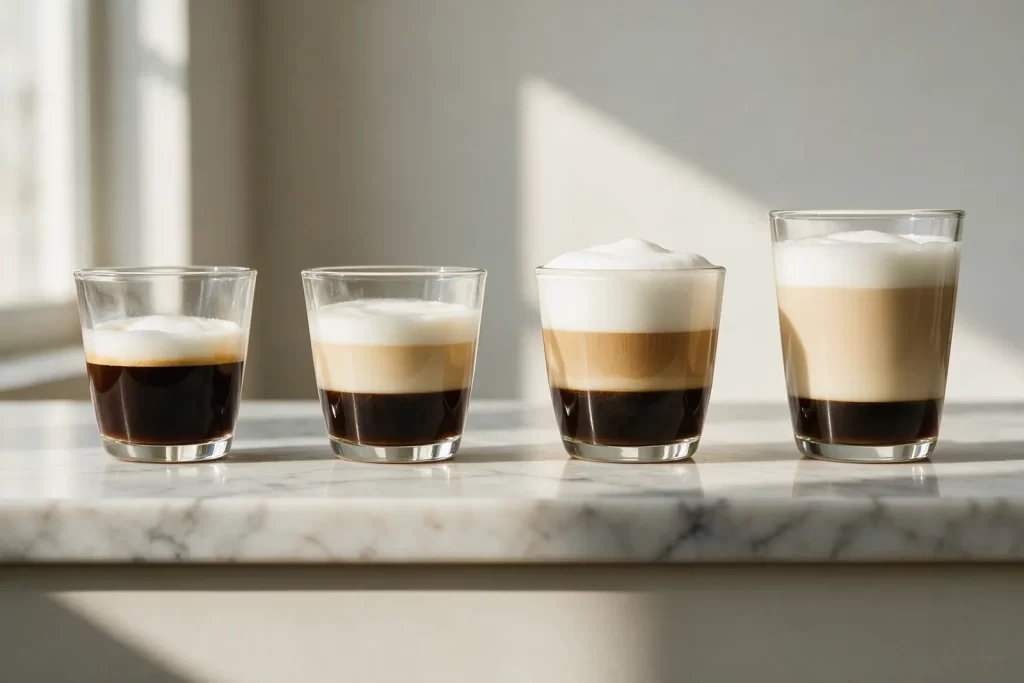
The milk version of the “stain”: a tall glass of about 200 ml of steamed milk with foam, into which a shot of espresso is poured slowly so it settles between the milk and the foam, creating three visible layers. It is milder than a latte because the espresso is not mixed through.
8. Caffè latte
The world’s favourite milk coffee. A single or double espresso with 150 to 300 ml of steamed milk and a thin layer of microfoam (about 1 cm), so the ratio of espresso to milk runs from about 1:4 to 1:6. It is creamy, mild and the best canvas for latte art. In Italy, ask for a “latte” and you will get a glass of milk; order a caffè latte. Want it cold? Our recipe for an iced latte at home keeps the same ratio over ice.
9. Cappuccino
The traditional Italian cappuccino is a single shot of espresso with roughly equal thirds of espresso, steamed milk and thick foam, in a 150 to 180 ml cup. The foam layer is the defining feature: at least 1 to 2 cm thick, airy and dense. Its name comes from the brown habits of the Capuchin friars, whose colour the drink resembles. A “dry” cappuccino has more foam and less milk; a “wet” one the reverse.
10. Flat white
Born in Australia and New Zealand in the 1980s, the flat white is a double espresso (often ristretto) with about 100 to 120 ml of silky microfoam, served in a 150 to 180 ml cup. There is no stiff foam cap, only a thin, glossy layer, so the drink feels velvety and tastes noticeably stronger than a latte of the same size because there is less milk diluting the coffee.
11. Breve
An American twist on the latte that swaps milk for steamed half-and-half, a mix of milk and cream that by US federal standards contains between 10.5% and 18% milkfat (21 CFR 131.180). The result is rich, almost dessert-like and naturally sweeter-tasting, with noticeably more calories: about 315 kcal per 240 ml of half-and-half compared with about 150 kcal for whole milk (USDA FoodData Central).
12. Mocha (caffè mocha)
A latte with chocolate. Typically one or two shots of espresso, 15 to 30 g of chocolate sauce or cocoa, and 150 to 250 ml of steamed milk, often finished with whipped cream or a dusting of cocoa. The name comes from the port of Mocha in Yemen, once the hub of the world coffee trade, whose beans were said to have a chocolatey note.
Filter coffee and other brewing methods
Brewed coffee is less concentrated than espresso but you drink much more of it, so a mug usually contains more caffeine than a single shot. The basic rule for all filter methods is a coffee-to-water ratio of about 1:15 to 1:17: roughly 15 g of ground coffee for a 240 ml mug.
13. Drip coffee
The automatic coffee maker’s cup: water at 90 to 96 °C dripping over medium-ground coffee in a paper or metal filter. Clean, light-bodied and easy to make in large batches. If it tastes weak, the culprit is nearly always too little coffee, because the “cups” printed on a coffee maker are only 5 to 6 oz (150 to 180 ml).
14. Pour-over
Drip coffee by hand, using a cone such as the Hario V60, Chemex or Kalita Wave. Controlling the pour gives a clean, aromatic cup that shows off the origin of the beans, which is why it is the go-to method for light roast coffee. Start with 15 g of coffee to 250 ml of water; our V60 pour-over guide walks through every step.
Pour over (V60)
- Coffee
- 15 g
- Water
- 250 ml
- Grind
- Medium-fine
- Water temp
- 94–96 °C
- Time
- 2:30–3:30 min
15. French press
Coarse coffee steeped in hot water for about 4 minutes, then separated with a metal mesh plunger. Because no paper filter traps the oils, the cup is full-bodied and slightly textured. It is the brewer I reach for most weekends; I settle on a 1:14 ratio, which holds up well to a splash of milk.
French press
- Coffee
- 30 g
- Water
- 420 ml
- Grind
- Coarse
- Water temp
- 93–96 °C
- Time
- 4 min
16. Moka pot coffee
The stovetop pot found in almost every Italian and Spanish kitchen. Steam pressure (around 1 to 1.5 bar) pushes water up through the coffee, producing a strong, intense brew at about 1:7 to 1:10. It is not true espresso, which needs around 9 bar, but it makes excellent cortados and lattes at home. Other strong traditional styles worth knowing are Turkish coffee, very finely ground coffee simmered with water (and often sugar) in a small pot called a cezve, and served unfiltered.
Cold coffee drinks
There are two ways to make coffee cold, and they taste very different. You can brew hot coffee and chill it over ice, which keeps the bright, aromatic notes, or you can brew with cold water over many hours, which gives a smoother, chocolatey and less acidic result.
17. Iced coffee and iced latte
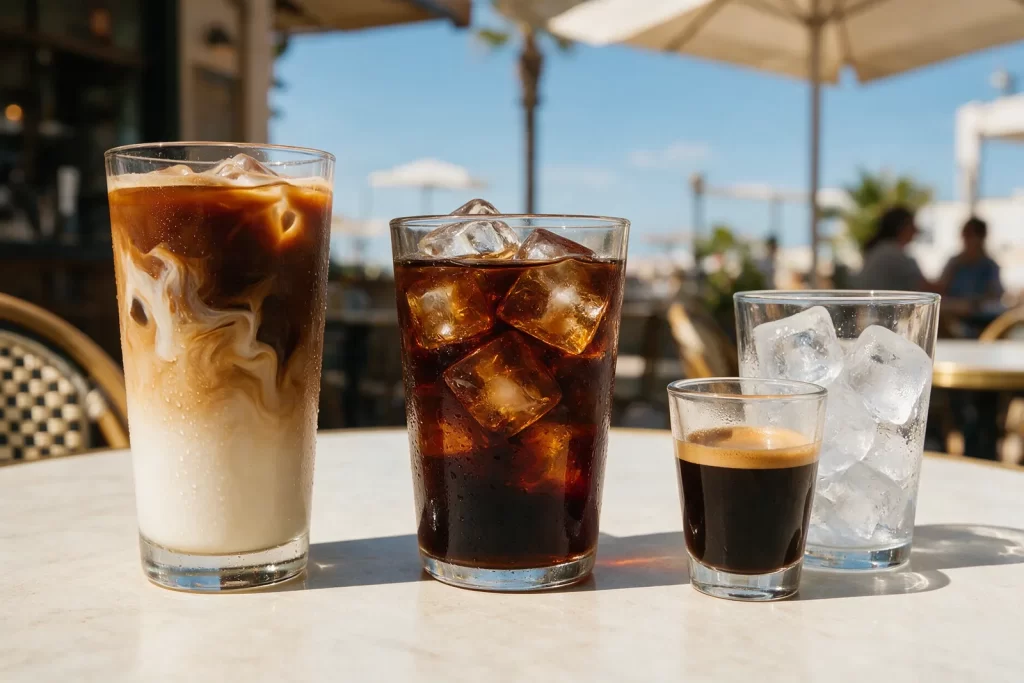
Classic iced coffee is filter coffee brewed about twice as strong and poured directly over ice so the melting ice brings it back to normal strength. An iced latte is a double espresso over ice with 150 to 200 ml of cold milk. In Spain you will also find the café con hielo: you are served a hot espresso and a glass of ice, and you pour one over the other yourself.
18. Cold brew
Coarsely ground coffee steeped in cold or room-temperature water for 12 to 24 hours, then filtered. It is typically made as a concentrate at 1:4 to 1:8 and diluted with water or milk before drinking. Smooth, sweet and low in perceived bitterness. Learn how to make cold brew concentrate step by step, or check the numbers in our cold brew ratio chart.
Cold brew concentrate
- Coffee
- 100 g
- Water
- 500 ml
- Grind
- Coarse
- Water temp
- Fridge or room temp
- Time
- 12–18 h
An honourable mention goes to the affogato, a scoop of vanilla gelato “drowned” in a hot shot of espresso. Is it a drink or a dessert? Both, and it takes 30 seconds.
Coffee with alcohol and specialty drinks (Irish coffee, café bombón)
19. Irish coffee
Hot brewed coffee, brown sugar and Irish whiskey, topped with a layer of lightly whipped cream that floats on the surface. The drink is credited to chef Joe Sheridan, who served it to cold, delayed passengers at the Foynes flying-boat terminal in Ireland in 1943; San Francisco’s Buena Vista Café made it famous in the US in 1952. The classic proportions are about 120 ml of coffee, 40 ml of whiskey, 1 to 2 teaspoons of brown sugar and 30 ml of cream. The sugar matters: it makes the coffee dense enough for the cream to float.
20. Café bombón
A Spanish favourite, said to come from Valencia: equal parts sweetened condensed milk and espresso (about 30 ml of each) served in a small glass so you can see the two layers, which you stir together before drinking. It is very sweet, thick and intense. A close cousin is Vietnamese cà phê sữa, which also uses condensed milk but with strong coffee from a phin filter, often over ice.
Coffee drink ratios: the infographic
Here is the whole menu in one table. Volumes are for a traditional serving; café chains often double the milk. Caffeine figures are approximate and assume Arabica beans: a single espresso shot has about 63 mg and an 8 oz brewed coffee about 95 mg, according to USDA data. Robusta beans contain roughly twice as much caffeine, as we explain in Arabica vs Robusta.
| Drink | Espresso / coffee | Milk or other | Foam | Typical size | Caffeine (approx.) |
|---|---|---|---|---|---|
| Espresso | 1 shot (30 ml) | None | Crema only | 30 ml | 63 mg |
| Ristretto | 1 short shot (15–20 ml) | None | Crema only | 20 ml | 50–60 mg |
| Lungo | 1 long shot (50–60 ml) | None | Crema only | 60 ml | 70–80 mg |
| Americano | 1–2 shots | Hot water 1:2–1:4 | Little crema | 150–240 ml | 63–126 mg |
| Espresso macchiato | 1–2 shots | None | 1–2 tsp | 60–90 ml | 63–126 mg |
| Cortado | 1–2 shots | Steamed milk 1:1 | Very little | 100–130 ml | 63–126 mg |
| Flat white | 2 shots (often ristretto) | 100–120 ml milk | Thin microfoam | 150–180 ml | 110–130 mg |
| Cappuccino | 1 shot | About ⅓ milk | About ⅓ thick foam | 150–180 ml | 63 mg |
| Caffè latte | 1–2 shots | 150–300 ml milk | About 1 cm | 240–350 ml | 63–126 mg |
| Latte macchiato | 1 shot | About 200 ml milk | Thick layer | 250–300 ml | 63 mg |
| Breve | 1–2 shots | Steamed half-and-half | Dense foam | 240–350 ml | 63–126 mg |
| Mocha | 1–2 shots | Chocolate + milk | Foam or whipped cream | 240–350 ml | 70–135 mg |
| Drip / pour-over | 15 g coffee | 240 ml water (1:16) | None | 240 ml | 95 mg |
| French press | 17 g coffee | 240 ml water (1:14) | None | 240 ml | 100–110 mg |
| Moka pot | 15–17 g coffee | 150 ml water | None | 50–60 ml per cup | 60–100 mg |
| Iced latte | 2 shots | 150–200 ml cold milk + ice | None | 350 ml | 126 mg |
| Cold brew | Concentrate 1:4–1:8 | Diluted 1:1 with water or milk | None | 240–350 ml | 150–250 mg |
| Irish coffee | 120 ml brewed coffee | 40 ml whiskey + sugar | Floating cream | 200 ml | 50–60 mg |
| Café bombón | 1 shot | 30 ml condensed milk | None | 60 ml | 63 mg |
For more detail on how much caffeine is in each cup and what affects it, see our full guide to caffeine in coffee.
How to choose your coffee
- You want pure coffee flavour: espresso, ristretto, americano or a pour-over.
- You want strong but a little softer: macchiato, cortado or flat white.
- You want creamy and mild: latte, latte macchiato or, for a treat, a breve.
- You love foam: cappuccino.
- You have a sweet tooth: mocha or café bombón.
- It is hot outside: iced latte, cold brew or a café con hielo.
At home, a moka pot or a basic espresso machine like my Krups covers almost the whole espresso side of this list. A milk frother or steam wand turns the same shot into a cortado, cappuccino or latte; only the amount of milk and foam changes. Keep the machine descaled every month or two so the shots stay hot and consistent.
FAQ
What is the strongest type of coffee?
It depends on what you mean by strong. By concentration, the ristretto and espresso are the strongest: about 63 mg of caffeine in just 30 ml, roughly 2 mg per ml, compared with about 0.4 mg per ml in filter coffee. By total caffeine per serving, a large cold brew or a big mug of drip coffee usually wins, often 150 to 250 mg, because you drink much more of it. Coffee made with Robusta beans can contain about twice the caffeine of Arabica. Remember that the FDA cites 400 mg a day as an amount not generally associated with negative effects for healthy adults.
What is the difference between latte, cappuccino and flat white?
All three are espresso with steamed milk; the difference is the amount of milk and foam. A cappuccino is small (150 to 180 ml) with roughly equal parts espresso, milk and a thick cap of foam. A flat white is the same size but uses a double shot and only a thin layer of silky microfoam, so it tastes the strongest. A latte is the largest (240 ml or more), with much more milk and about 1 cm of foam, so it is the mildest and creamiest.
What is the difference between an americano and regular coffee?
An americano is espresso diluted with hot water, while regular coffee is brewed by passing hot water through coarser grounds without pressure. They can have similar strength, but the americano has a rounder, slightly more roasted flavour and a little crema on top.
Which coffee drink has the least caffeine?
Among standard drinks, a single-shot cappuccino or latte macchiato (about 63 mg) or a ristretto (slightly less) are the lowest. For almost no caffeine, choose decaf: EU rules cap decaffeinated roasted coffee at 0.1% caffeine, and US decaf typically has at least 97% removed, leaving around 2 to 15 mg per cup.
About the author
Keep reading
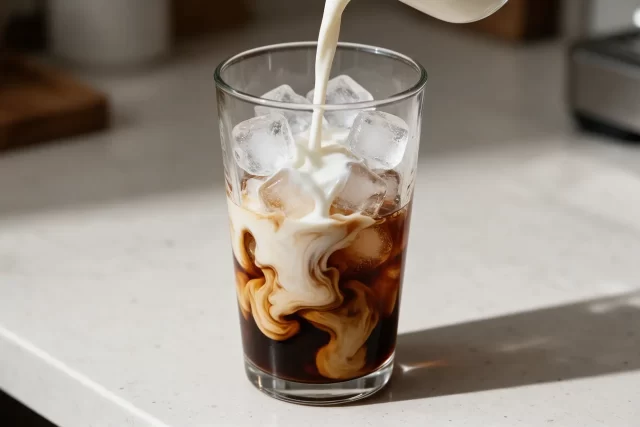
Iced Latte at Home, With or Without an Espresso Machine
An iced latte is just strong coffee, cold milk and ice. The trick is making the coffee strong enough that the ice and milk do not wash it…