Espresso vs Coffee: What’s the Difference? (Caffeine, Taste, Brewing)
Espresso vs coffee: same beans, different brewing. Grind, pressure, ratio, caffeine per shot and per cup, and which one is really stronger.
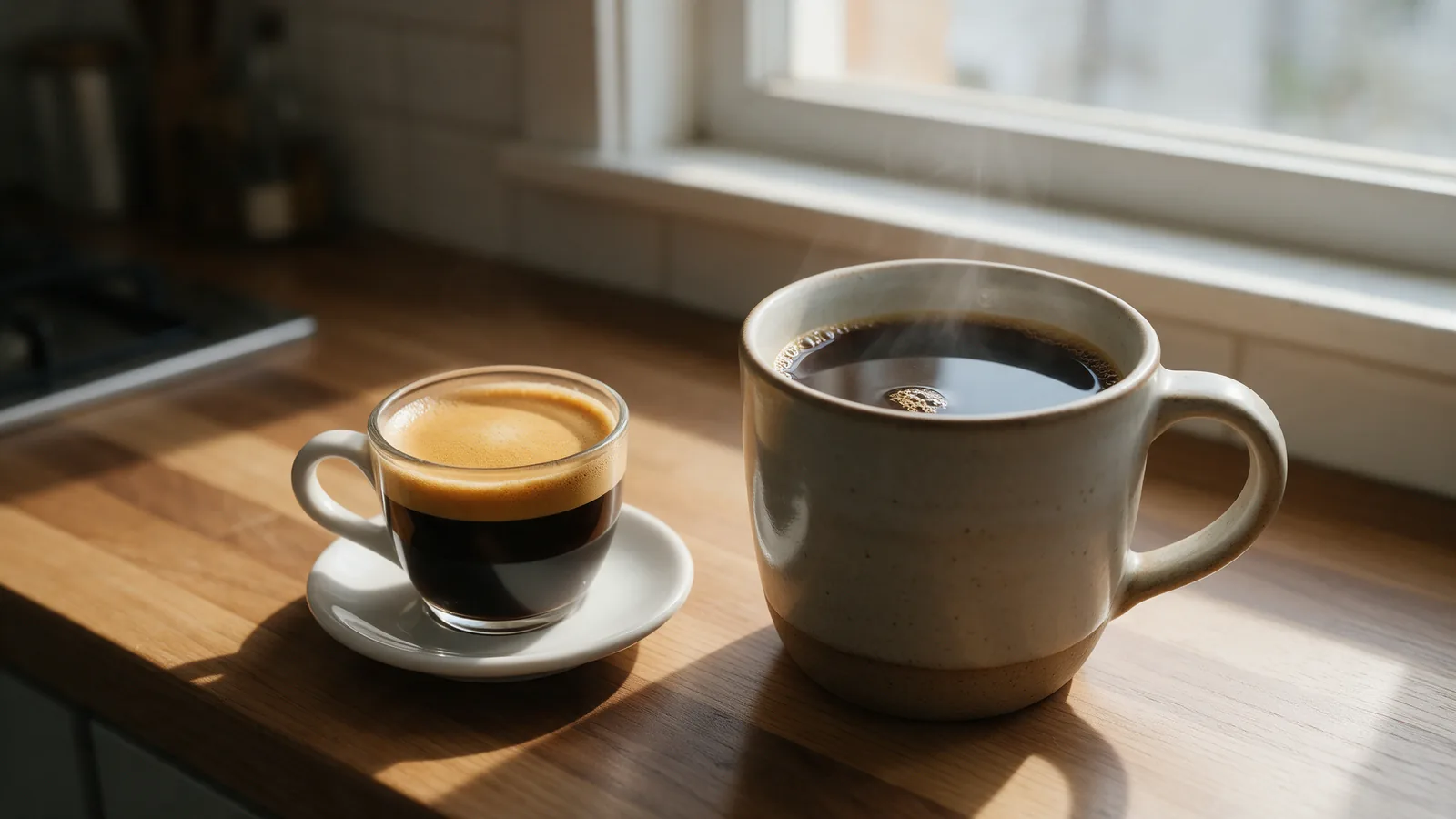
What is the difference between espresso and coffee? The short answer to the espresso vs coffee question: espresso is coffee, made from the same beans, but brewed in a different way: about 18 g of finely ground coffee is pushed through with hot water at roughly 9 bar of pressure for 25–30 seconds, giving a small, thick 30–40 ml shot topped with crema. Regular drip or filter coffee uses a coarser grind, no pressure and 4–6 minutes of contact, and much more water (around 1:16 instead of 1:2). The result: espresso is about five times more concentrated per millilitre and tastes more intense, but a typical mug of drip coffee (about 95 mg of caffeine) still holds more caffeine than a single shot of espresso (about 63 mg).
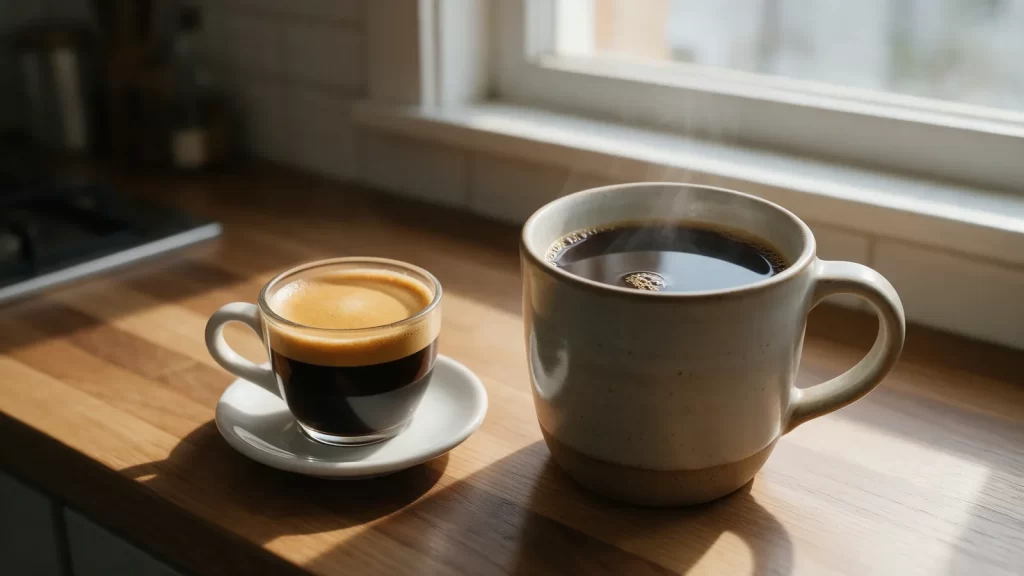
What is espresso?
Espresso is a short, concentrated coffee made by forcing hot water through a compact “puck” of finely ground coffee under pressure. The word comes from Italian and refers to coffee made “expressly”, on demand, for one person. The first commercial machines appeared in Milan in the early 1900s (Luigi Bezzera patented his in 1901), and the modern style, with its layer of crema, dates from Achille Gaggia’s lever machines in the late 1940s, which pushed the pressure high enough to emulsify the coffee’s oils and gases.
The Italian Espresso National Institute still describes a classic single espresso with very precise numbers: about 7 g of ground coffee, water at 88 °C (±2), a pressure of 9 bar (±1), an extraction time of 25 seconds (±5) and 25 ml (±2.5) in the cup. Most specialty cafés today serve a double as standard: around 18 g of coffee giving 36–40 g of liquid in 25–30 seconds.
Three things make an espresso recognisable at a glance:
- Volume: 25–40 ml for a single or a typical modern shot, roughly one fluid ounce.
- Body: thick, almost syrupy, because pressure pulls out oils and fine particles that a paper filter would hold back.
- Crema: the hazelnut-coloured foam on top, made of tiny bubbles of carbon dioxide trapped in coffee oils. Fresh beans give more crema; old beans give little or none.
So what is espresso coffee, in one line? It is not a type of bean or a type of roast; it is a brewing method. You can make espresso with a light roast, a dark roast, Arabica or a blend with some Robusta (if you are curious about the second one, see our guide to Arabica vs Robusta).
Espresso vs coffee: the key differences (table)
When people say “coffee” in this comparison they usually mean drip or filter coffee: an electric drip machine, a pour-over such as the V60, or a batch brew in a café. Here is how the two methods differ side by side.
| Espresso | Drip / filter coffee | |
|---|---|---|
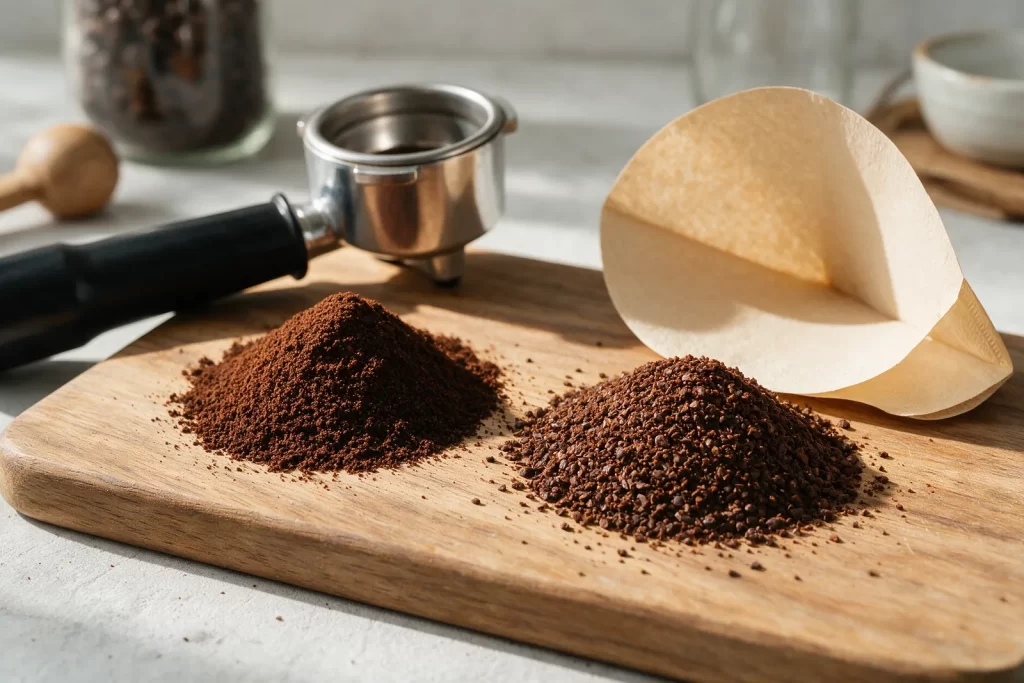
| Grind size | Fine, like powdered sugar (≈200–300 µm) | Medium, like sea salt (≈600–900 µm) |
| Pressure | ≈9 bar from a pump or lever | None, gravity only (≈1 bar) |
| Water temperature | 88–94 °C | 92–96 °C |
| Brew time | 25–30 seconds | 3–6 minutes |
| Ratio (coffee : drink) | ≈1:2 (18 g → 36 g) | ≈1:15 to 1:17 (15 g → 250 ml) |
| Serving size | 30 ml single, 60 ml double | 240–350 ml mug |
| Strength (TDS) | 8–12% | 1.15–1.45% |
| Caffeine per serving | ≈63 mg (single) / ≈126 mg (double) | ≈95 mg per 240 ml |
| Texture | Thick, with crema | Light, clean, no foam |
| Equipment | Espresso machine (≈€150 and up) | Drip machine, pour-over cone or French press |
Grind size
Espresso needs a fine grind because the water only has about half a minute to dissolve the flavour. Smaller particles expose more surface and also create the resistance the pump pushes against: too coarse and the shot gushes out in 10 seconds, sour and watery; too fine and it drips out in 45 seconds, bitter and harsh. Drip coffee uses a medium grind because the water already spends several minutes with the grounds. If you used espresso-fine coffee in a drip machine, the filter would clog and the coffee would over-extract.
This is also why a good grinder matters more for espresso than for any other method. Small changes of a few microns move the shot time by several seconds. Pre-ground supermarket coffee labelled “for espresso” works in a pressurised (dual-wall) basket, which many home machines include, but rarely in a standard basket.
Pressure
This is the real dividing line. An espresso machine pushes water through the coffee at around 9 bar, nine times atmospheric pressure. That pressure is what extracts oils, emulsifies them into crema and gives espresso its syrupy body. Drip coffee has no added pressure: water simply falls through the bed of coffee.
Many pump machines advertise “15 bar” or “19 bar”. That is the maximum the pump can produce, not what reaches the coffee; a well-set machine brews at about 9 bar at the group head. A stovetop moka pot, by contrast, only reaches about 1–2 bar, so although its coffee is strong and concentrated, it is not technically espresso. As someone who brews with both a moka pot and a Krups home espresso machine, I can tell you the difference shows up immediately in the cup: the moka gives a strong, slightly bitter coffee with no real crema, the machine a thicker, rounder shot.
Time
Espresso is the fastest brew there is: 25–30 seconds from the moment the pump starts. Drip coffee needs 3–4 minutes for a single pour-over and 5–6 minutes for a full carafe. Both are aiming for the same thing, an extraction of roughly 18–22% of the coffee’s soluble material, but they get there by opposite routes: espresso uses fine grind and pressure to go fast, filter coffee uses more water and more time.
Ratio of coffee to water
The ratio explains most of the difference in strength. A standard espresso uses about 1 part coffee to 2 parts liquid (18 g of ground coffee for 36 g of espresso). A ristretto goes tighter, around 1:1 to 1:1.5, and a lungo looser, around 1:3 to 1:4. Filter coffee uses around 1:15 to 1:17, which is about 15 g of coffee for a 250 ml mug (our coffee per cup chart has the scoops and tablespoons for every method).
Espresso (double shot) Drip / filter coffee
Is espresso stronger than coffee?
It depends on what you mean by “stronger”, and the answer is different for taste and for caffeine.
In taste and concentration, yes, by a lot. Coffee professionals measure strength as total dissolved solids (TDS), the percentage of the drink that is dissolved coffee. The Specialty Coffee Association’s brewing chart puts good filter coffee at 1.15–1.45% TDS. Espresso usually lands between 8% and 12%. In other words, a sip of espresso carries six to eight times more dissolved coffee than a sip of drip, which is why it tastes so intense, so heavy and, when badly made, so bitter.
In caffeine per cup, usually no. Because you drink 30 ml of one and 240 ml or more of the other, the total amount of caffeine often ends up higher in the big mug. We break this down in the next section.
Roast level is a separate question. “Espresso roast” beans are often roasted darker so they taste rich and less acidic in a concentrated shot, but darkness does not mean more caffeine; by weight, light and dark roasts are almost identical (more on that in our guide to light roast coffee).
Caffeine: per serving and per ml
Here are reference figures from the US Department of Agriculture’s FoodData Central database, which are the numbers most nutrition labels and studies use:
| Drink | Serving | Caffeine | Per ml |
|---|---|---|---|
| Espresso, single | 30 ml (1 fl oz) | ≈63 mg | ≈2.1 mg |
| Espresso, double | 60 ml (2 fl oz) | ≈126 mg | ≈2.1 mg |
| Drip coffee | 240 ml (8 fl oz) | ≈95 mg | ≈0.4 mg |
| Drip coffee | 350 ml (12 fl oz) | ≈140 mg | ≈0.4 mg |
| Americano (2 shots + water) | 350 ml | ≈126 mg | ≈0.36 mg |
So, does espresso have more caffeine than coffee? Per millilitre, about five times more. Per serving, a single shot has about a third less than an 8 oz mug, and a double shot ends up slightly ahead. Real values vary widely with the beans (Robusta has roughly twice the caffeine of Arabica), the dose and the size of the cup, so treat these as averages, not exact amounts.
For context, the US Food and Drug Administration and the European Food Safety Authority both consider up to 400 mg of caffeine a day safe for most healthy adults, and EFSA suggests keeping a single dose to about 200 mg and staying at or below 200 mg a day during pregnancy. That is about six single espressos or four mugs of drip coffee. You will find a full table by drink, brand and cup size in our guide on how much caffeine is in coffee.
Taste, body and health differences
Flavour. Espresso concentrates everything: sweetness, acidity, bitterness and aroma. Small defects that you would barely notice in a mug of filter coffee become obvious. Filter coffee, by contrast, is lighter and more transparent; it is often the better way to taste the fruity or floral notes of a light-roast single origin.
Body. Paper filters trap most coffee oils and very fine particles, so filter coffee feels clean and tea-like. Espresso keeps those oils and fines in the cup, which gives it a creamy, heavy mouthfeel.
Cholesterol. Those oils include cafestol and kahweol, two compounds that can raise LDL cholesterol in large amounts. Paper-filtered coffee contains almost none. Espresso has more per ml, but because servings are small, studies such as the large Tromsø study in Norway (published in Open Heart in 2020) found its effect sits between filtered coffee and unfiltered methods like the French press. If your cholesterol is high, paper-filtered coffee is the safest everyday choice.
Calories. On their own both are almost calorie-free: a shot of espresso has 1–3 kcal and a mug of black drip coffee about 2 kcal. The calories come from milk, sugar and syrups.
Can you make espresso with regular coffee?
Yes. There is no special “espresso bean”. Any roasted coffee can be used for espresso as long as it is ground fine enough and brewed under pressure. The beans sold as “espresso” are usually blends and roasts (often medium-dark) that taste balanced and sweet when concentrated, but nothing stops you from pulling a shot of a light roast or making filter coffee with “espresso” beans.
What does not work is the reverse with pre-ground coffee: a bag ground for drip machines is too coarse for a standard espresso basket, so the shot runs fast, thin and sour. If you only have pre-ground drip coffee, a pressurised basket, a moka pot or an AeroPress will give you something closer to espresso than an unpressurised machine will.
A few practical tips if you are starting out at home:
- Use beans roasted within the last 2–6 weeks; very fresh beans (under a week) can be gassy and erratic.
- Weigh your dose and your shot with a cheap scale with 0.1 g resolution. It is the fastest way to consistent espresso.
- Change one variable at a time, usually the grind, and aim for 25–30 seconds.
- Keep the machine clean and descaled: limescale lowers the temperature and pressure (here is how to descale an espresso machine).
Drinks made from espresso
One of the biggest practical differences is that espresso is a building block. Almost every drink on a café menu starts with one or two shots:
- Ristretto: a shorter, sweeter shot of about 15–20 ml.
- Lungo: a longer shot of 50–90 ml run through the same coffee; more bitter than an americano.
- Americano: espresso topped up with hot water, close in strength to filter coffee but with a different, heavier taste.
- Macchiato: espresso “stained” with a spoonful of milk foam.
- Cortado: espresso with an equal amount of warm milk.
- Cappuccino: espresso with steamed milk and a thick layer of foam, about 150–180 ml.
- Flat white: a double shot with thin, velvety milk, about 160 ml.
- Latte: espresso with plenty of steamed milk, 240 ml or more, also lovely cold (see our iced latte recipe).
- Mocha: a latte with chocolate.
Drip coffee, on the other hand, is mostly drunk as is, black or with a splash of milk. If you want the full list with ratios, our guide to the types of coffee drinks covers twenty of them.
Which one should you choose?
- Choose espresso if you like intense, short coffees, want to make milk drinks at home, or want a caffeine hit in a few sips.
- Choose drip or filter coffee if you prefer a large mug to sip slowly, want to taste the delicate notes of light roasts, need to make coffee for several people at once, or want to spend less on equipment.
- Somewhere in between: a moka pot or an AeroPress gives a strong, concentrated coffee for a fraction of the cost of an espresso machine, and a V60 pour-over is the best way to get a café-quality filter cup at home.
FAQ
Does espresso have more caffeine than coffee?
Per millilitre, yes: about 2.1 mg/ml versus 0.4 mg/ml for drip coffee. Per serving, usually not: a single 30 ml shot has about 63 mg, while a 240 ml mug of drip coffee has about 95 mg. A double espresso (about 126 mg) has a little more than an 8 oz mug.
Can you make espresso with regular coffee?
Yes. Espresso is a brewing method, not a type of bean. Any coffee works if you grind it fine (close to powdered sugar) and brew it at about 9 bar in 25–30 seconds. Pre-ground drip coffee is usually too coarse for a standard basket, but works better in a pressurised basket.
What is a shot of espresso?
A single shot is about 30 ml (1 fl oz) of espresso brewed from 7–9 g of finely ground coffee; a double shot is about 60 ml from 14–18 g. Many cafés now serve a double as their standard “espresso”.
Is espresso healthier than regular coffee?
Neither is clearly healthier. Both are nearly calorie-free and rich in antioxidants. Paper-filtered coffee removes most of the cafestol that can raise LDL cholesterol, so it is the better daily choice if your cholesterol is high; espresso sits in the middle.
Is a moka pot espresso?
Not technically. A moka pot brews at about 1–2 bar, far below espresso’s 9 bar, so it makes a strong, concentrated coffee without real crema. It is a good, cheap alternative for milk drinks at home.
Why is espresso served in such a small cup?
Because it is very concentrated (8–12% dissolved solids) and is meant to be drunk in two or three sips while it is hot and the crema is intact. The thick walls of a demitasse cup also keep that small volume warm.
About the author
Keep reading
How to Descale an Espresso Machine (Step by Step)
When to descale, what to use instead of vinegar, and the exact steps to clear limescale from your espresso machine in about 30 minutes.