French Press Coffee Ratio: How Much Coffee to Use (Chart)
The best French press coffee ratio is 1:15: 30 g of coarse coffee for 450 ml of water. Chart by press size, grind, steps and fixes for bitter cups.
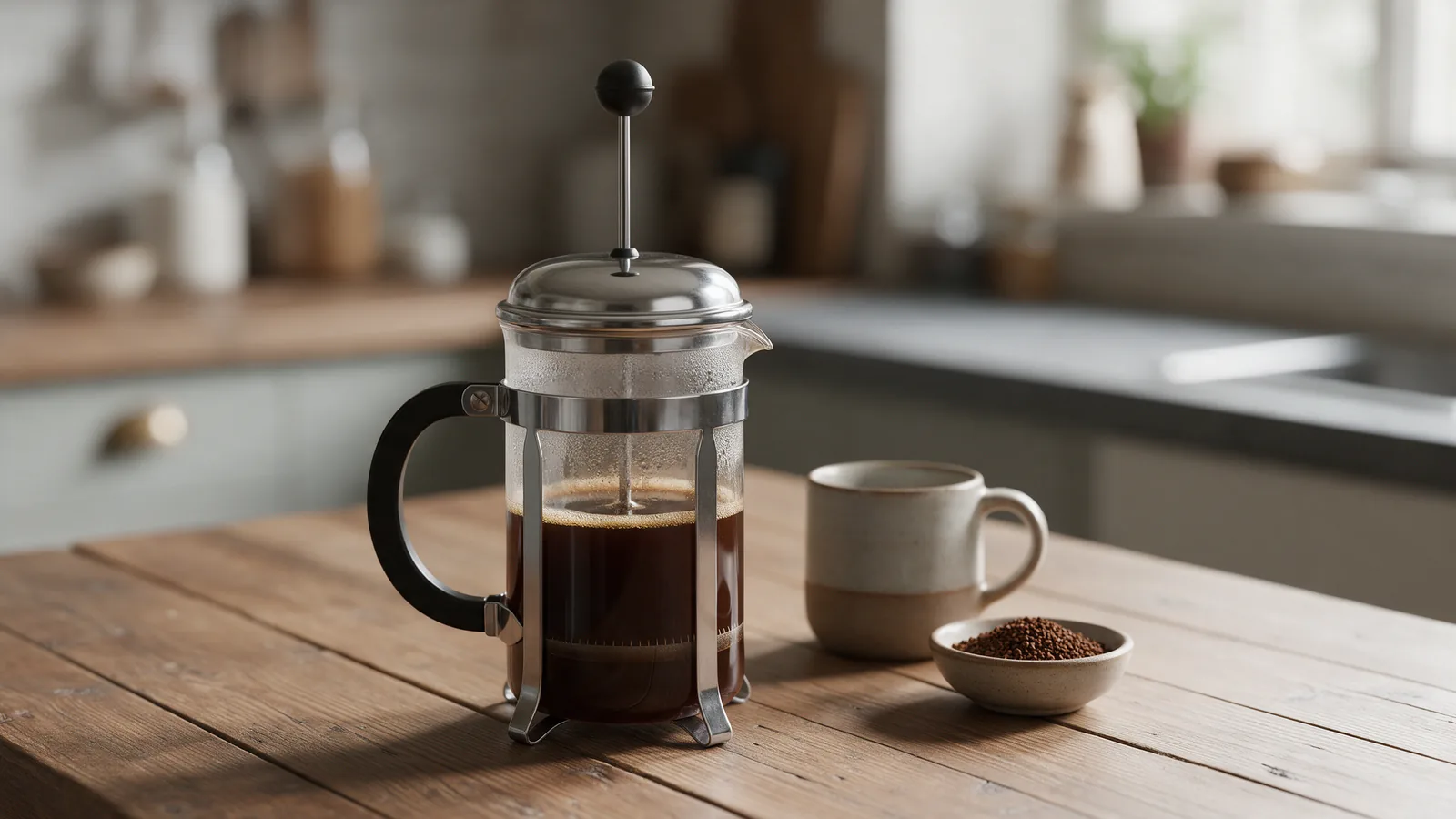
The best French press coffee ratio is 1:15: 1 gram of coffee for every 15 grams (ml) of water, which works out to about 30 g of coarse ground coffee for 450 ml of water in a standard 4-cup press, or 60 g for a full 1-litre press. Most people land somewhere between 1:12 (strong and heavy) and 1:16 (lighter and cleaner). Use water at 93–96 °C, steep for 4 minutes, press slowly and pour everything out straight away. If you don’t have a scale, start with 2 rounded tablespoons (about 14 g) per 8 oz (240 ml) mug.
The French press (also called a cafetière or coffee plunger) is the brewer I reach for most at home on slow mornings. It is cheap, it needs no paper filters, and it is the most forgiving way to make full-bodied coffee. But it is also the brewer people get wrong most often, and almost always for the same reason: the amount of coffee. Below you will find the ratio, a chart for every common press size, the grind and the step-by-step method I use, plus the fixes for gritty or bitter cups.
The ideal French press coffee ratio (1:12 to 1:15)
A coffee ratio is simply the weight of coffee compared with the weight of water. Because 1 ml of water weighs 1 g, a 1:15 ratio means 20 g of coffee for 300 ml of water, 30 g for 450 ml, and so on. Weighing in grams is the only way to make the same cup twice, since a spoonful of coffee can vary by 40% depending on grind size and how heaped it is.
For drip and pour-over coffee, the Specialty Coffee Association’s “Golden Cup” guideline is about 55 g of coffee per litre, or roughly 1:18. Immersion brewers like the French press usually taste better a little stronger than that, because the metal mesh lets oils and fine particles through and the coffee steeps in all of its water at once. That is why the common French press range is 1:12 to 1:16:
| Ratio | Coffee per litre | What it tastes like | Best for |
|---|---|---|---|
| 1:12 | 83 g | Very strong, heavy, syrupy | Adding milk, dark roasts, a “kick” |
| 1:13 | 77 g | Strong and rich | Coffee with a splash of milk |
| 1:15 | 67 g | Balanced, full body | The everyday starting point |
| 1:16 | 62 g | Lighter, clearer, more aromatic | Light roasts, black coffee |
| 1:17 or more | 59 g or less | Often thin and watery | Rarely recommended |
My advice: start at 1:15, taste it black, and only then move one step at a time. If it feels thin, try 1:14 or 1:13; if it feels heavy or bitter, try 1:16 before changing anything else. For comparison with other brewers, see our guide to how much coffee per cup, which lists the ratio for drip, pour-over, espresso, moka and cold brew.
French press (classic)
- Coffee
- 30 g, medium roast
- Water
- 450 ml
- Grind
- Coarse
- Water temp
- 93–96 °C
- Time
- 4 min + 1–2 min rest
How much coffee for a French press: chart by press size
French press “cups” are a trap. Bodum and most other brands measure a cup as about 4 oz (120–125 ml), not a full 8 oz mug. So an “8-cup” press holds about 1 litre, which is four normal mugs. Also, you never use the full nominal volume: the grounds and the plunger take up space, so you pour in a bit less water. The chart below uses realistic water amounts.
| Press size (nominal) | Water to use | Coffee at 1:15 | Coffee at 1:12 (strong) | Rounded tablespoons (≈7 g) at 1:15 |
|---|---|---|---|---|
| 3-cup (350 ml / 12 oz) | 300 ml | 20 g | 25 g | 3 |
| 4-cup (500 ml / 17 oz) | 450 ml | 30 g | 37 g | 4–5 |
| 8-cup (1 L / 34 oz) | 900 ml | 60 g | 75 g | 8–9 |
| 12-cup (1.5 L / 51 oz) | 1,350 ml | 90 g | 112 g | 13 |
| Per 8 oz mug | 240 ml | 16 g | 20 g | 2–2½ |
Tablespoon counts assume a rounded tablespoon of coarse ground coffee, about 7 g. A level tablespoon holds closer to 5 g, so if you level your spoon, add roughly 40% more spoons. Coarse coffee is also less dense than fine coffee, which is one more reason the scale beats the spoon.
Making a single mug in a big press works, but the shallow bed of grounds cools quickly and extracts unevenly. If you often brew for one, a 350 ml press is worth having.
Grind size for French press: coarse
The French press uses a metal mesh filter with relatively large holes, and the coffee sits in water for several minutes. Both facts point to the same answer: a coarse grind, with particles around 0.8–1.2 mm, similar to coarse sea salt or dry breadcrumbs.
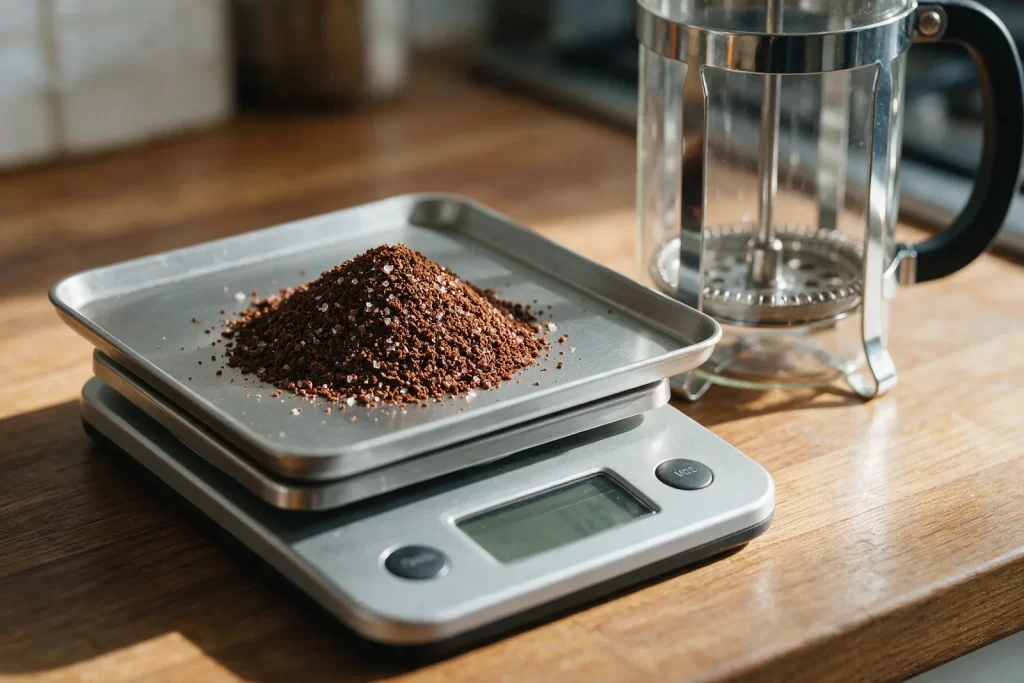
- Too fine (like table salt or finer): the plunger is hard to push, fine particles pass the mesh and end up as sludge, and the cup turns bitter and dry because the coffee over-extracts.
- Too coarse (like cracked peppercorns): the coffee tastes sour, thin and a bit like tea because the water can’t pull enough out in 4 minutes.
- Just right: the plunger goes down with gentle, steady pressure in about 15–20 seconds and the coffee tastes sweet and round.
A burr grinder makes a real difference here. Blade grinders produce a mix of dust and chunks, and the dust is what gives you mud in the cup. If you buy pre-ground coffee, look for bags labelled “French press” or “coarse”; standard supermarket ground coffee is cut for drip machines and is too fine. Roast matters too: medium and medium-dark roasts are the classic French press choice, while light roasts like a slightly finer grind and the 1:16 end of the range (more on roasts in what is light roast coffee).
How to make French press coffee, step by step
This is the method I use for a 4-cup (500 ml) press. Scale the numbers with the chart above.
- Heat the water. Bring about 600 ml of filtered water to the boil (the extra is for preheating), then let it rest for 30–60 seconds so it drops to around 93–96 °C. At high altitude, where water boils below 100 °C, you can use it straight away.
- Preheat the press. Pour a little hot water into the empty press, swirl and discard it. A cold glass carafe can steal several degrees from your brew.
- Weigh and grind. Weigh 30 g of whole beans and grind them coarse just before brewing. Ground coffee loses aroma within minutes.
- Add coffee and water. Put the press on the scale, add the grounds, tare, and pour 450 g of water, making sure all the grounds get wet. Start a 4-minute timer.
- Stir or break the crust. After about 1 minute, a crust of grounds floats on top. Give it 3–4 gentle stirs with a wooden spoon, or break it at the 4-minute mark (see the low-sediment method below).
- Press slowly. At 4 minutes, put the lid on and push the plunger down with gentle, even pressure. If it resists a lot, your grind is too fine; don’t force it, or hot coffee can spray out.
- Let it settle and pour. Wait 1–2 minutes so the fines sink, then pour all the coffee into mugs or a carafe. Leave the last 1–2 cm in the press: that is where the sludge lives.
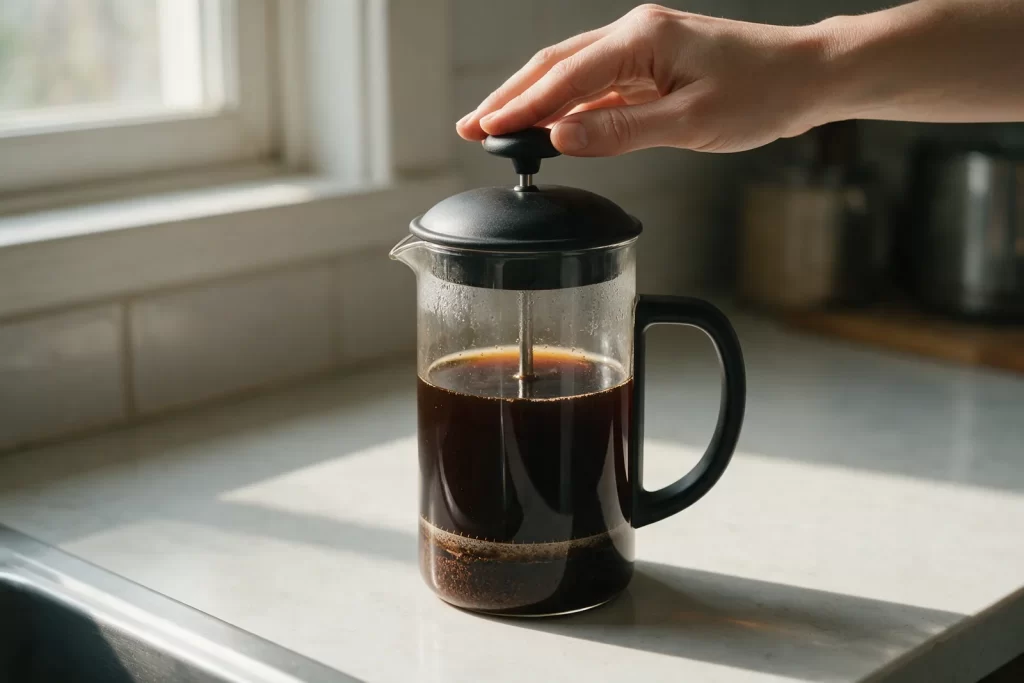
A low-sediment method (no plunging into the grounds)
Coffee writer and former World Barista Champion James Hoffmann popularised a slower technique that gives a noticeably cleaner cup. Brew as above for 4 minutes, then stir the crust so the grounds sink, skim off the foam and floating bits with two spoons, and wait another 5–8 minutes. Then press the plunger only to the surface of the coffee, using the mesh as a strainer rather than a piston, and pour gently. It takes longer, but the extra resting time lets almost all the fine particles settle at the bottom. I use this one at weekends; for a quick weekday coffee, the classic 4-minute version is fine. We cover steep times, including what happens if you leave it too long, in a separate guide.
Common French press mistakes (sediment and bitterness)
Gritty coffee with sediment in the cup
- Grind too fine, or uneven: switch to a coarser setting or a burr grinder.
- Pouring the last drops: stop pouring before the bottom of the press.
- Pressing too fast: a hard push stirs up the grounds and forces fines through the mesh. Take 15–20 seconds.
- Worn or bent filter: if grounds escape around the edge, the mesh or spring is damaged. Replacement filters are cheap.
A light haze and some body at the bottom of the mug are normal with a French press; that is part of its character. Real grit is not.
Bitter French press coffee
- Leaving the coffee in the press: the plunger does not stop extraction. Coffee keeps touching the grounds below the filter and slowly turns bitter and astringent. Decant everything straight away.
- Water straight off a rolling boil on a dark roast: let it rest for a minute.
- Too much coffee or too long: try 1:16 or cut the steep to 3½ minutes.
- A dirty press: old coffee oils turn rancid and taste bitter and stale.
Weak or sour French press coffee
- Not enough coffee: the most common error. One level tablespoon per “cup” in a big press can land you near 1:25. Weigh it.
- Water too cool: below about 90 °C extraction slows down.
- Grind too coarse or steep too short: go one step finer or add 30–60 seconds.
- Stale coffee: beans are at their best roughly 1–4 weeks after roasting.
Caffeine and health: what’s different about French press coffee
A 240 ml mug of French press coffee brewed at 1:15 typically contains around 80–135 mg of caffeine, in the same range as drip coffee (about 95 mg per 8 oz cup in USDA FoodData Central). Brewing stronger, at 1:12, pushes it higher. The FDA considers up to 400 mg a day generally safe for healthy adults, and the European Food Safety Authority (EFSA) suggests no more than 200 mg in a single serving and 200 mg a day during pregnancy. For drink-by-drink numbers, see how much caffeine is in coffee.
The real difference is the filter. Paper traps two coffee oils, cafestol and kahweol, while a metal mesh lets them through. Controlled trials summarised by Urgert and Katan (Annual Review of Nutrition, 1997) showed that cafestol raises LDL (“bad”) cholesterol, and unfiltered coffee such as French press, boiled or Turkish coffee contains far more of it than filter coffee. A large Norwegian cohort study (Tverdal et al., European Journal of Preventive Cardiology, 2020) also found that filtered coffee was linked to lower mortality than unfiltered coffee. One or two cups of French press a day is not a concern for most people, but if you drink several a day and your cholesterol is high, consider switching some of them to paper-filtered coffee such as a V60 pour over. This is general information, not medical advice.
How to clean a French press
A clean press is half the flavour. Coffee oils build up on the glass and especially inside the mesh, and they go rancid within days.
- Empty the grounds into the bin or compost, not down the sink: they clog drains. Add a little water, swirl, and tip the slurry into a sieve or the compost.
- Rinse after every use with hot water and a drop of washing-up liquid, pumping the plunger up and down a few times.
- Take the filter apart once a week. Unscrew the rod and separate the mesh, the spiral plate and the cross plate. Scrub them with a soft brush, rinse and dry before reassembling.
- Deep clean once a month: soak the parts for 15–30 minutes in hot water with a tablespoon of baking soda, or a 1:1 mix of white vinegar and water if you have hard water and white marks on the glass.
- Dishwasher: many borosilicate glass carafes and stainless steel parts are dishwasher safe, but check your model. Plastic frames and wooden handles usually are not.
Store the press dry, with the plunger out, so no water is trapped in the mesh.
French press vs other methods
The French press sits between filter coffee and espresso in body. Compared with a paper-filtered pour over, it gives a heavier, oilier cup with less clarity but more texture. Compared with espresso, it is far less concentrated: about 1.3–1.6% dissolved solids against 8–12% in a shot, as we explain in espresso vs coffee. And because it is an immersion brewer with a coarse grind, a French press is also one of the easiest ways to make cold brew: use about 1:5 to 1:8 with cold water and steep it in the fridge for 12–18 hours (full recipe in how to make cold brew concentrate).
FAQ
How many scoops of coffee for a French press?
Use about 1½ standard coffee scoops per 8 oz (240 ml) mug. A standard scoop holds 2 level tablespoons, about 10 g. That means 3 scoops for a 4-cup (500 ml) press and 6 scoops for an 8-cup (1 litre) press at 1:15. The small scoop that comes with a Bodum press holds roughly 7 g, so use about 2 of those per mug.
What grind for French press?
Coarse: particles around 0.8–1.2 mm, like coarse sea salt. It should feel chunky between your fingers, never powdery. On most burr grinders this is at or near the coarsest third of the range.
Can you make espresso in a French press?
No. Espresso needs water forced through finely ground coffee at about 9 bar of pressure for 25–30 seconds, and a French press works by gravity and steeping. You can make a strong, espresso-like concentrate for milk drinks: use a 1:8 ratio, a medium-coarse grind and a 4-minute steep, and mix it with frothed milk. It will taste good, but it will not have crema or the syrupy texture of a real shot.
How much coffee for a 32 oz French press?
A 32–34 oz (1 litre) press takes about 900 ml of water, so use 60 g of coffee at 1:15, or 75 g if you like it strong. That is about 8–9 rounded tablespoons or 6 standard scoops.
Should you stir French press coffee?
Yes, gently. A few stirs after a minute, or breaking the crust at 4 minutes, makes sure all the grounds are wet and extract evenly. Avoid stirring hard right before pressing, because it lifts the fines and gives a muddier cup.
Why is my French press plunger hard to push?
The grind is too fine, or there is simply too much coffee for the press. Fine particles clog the mesh and create resistance. Lift the plunger slightly, then press again more slowly, and use a coarser grind next time.

About the author
Keep reading
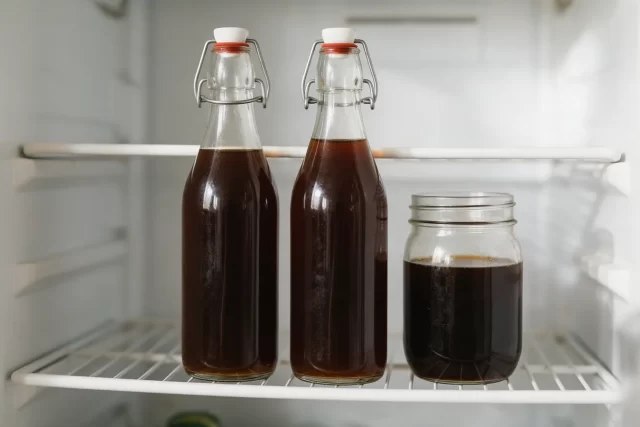
How Long Does Cold Brew Last in the Fridge? (And Can You Heat It Up?)
Cold brew concentrate lasts up to 2 weeks in the fridge, diluted 3–4 days, with milk 1–2. Signs it's gone bad, storage tips and how to heat it up.
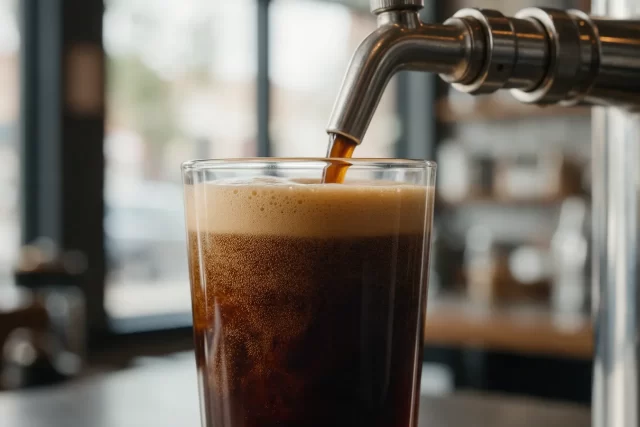
What Is Nitro Cold Brew? Taste, Caffeine and How It’s Made
What is nitro cold brew? Cold brew charged with nitrogen and poured from a tap: creamy, no dairy, about 265 mg caffeine per 16 oz. How to make it at home.
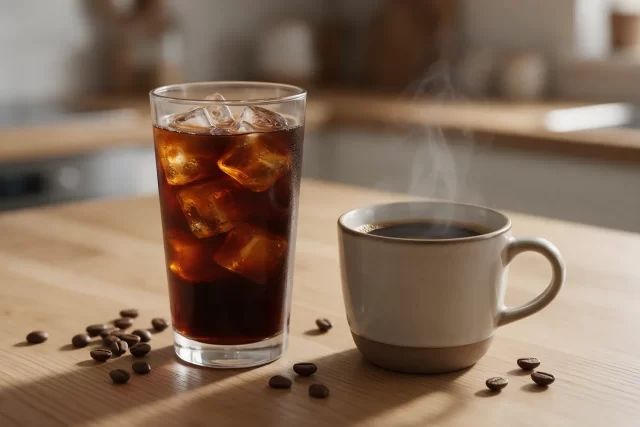
Does Cold Brew Have More Caffeine Than Regular Coffee?
Does cold brew have more caffeine? Usually: 150–250 mg per 12 oz glass vs about 140 mg for drip. Why it varies, a table vs espresso and how to cut it.