Does Cold Brew Have More Caffeine Than Regular Coffee?
Does cold brew have more caffeine? Usually: 150–250 mg per 12 oz glass vs about 140 mg for drip. Why it varies, a table vs espresso and how to cut it.
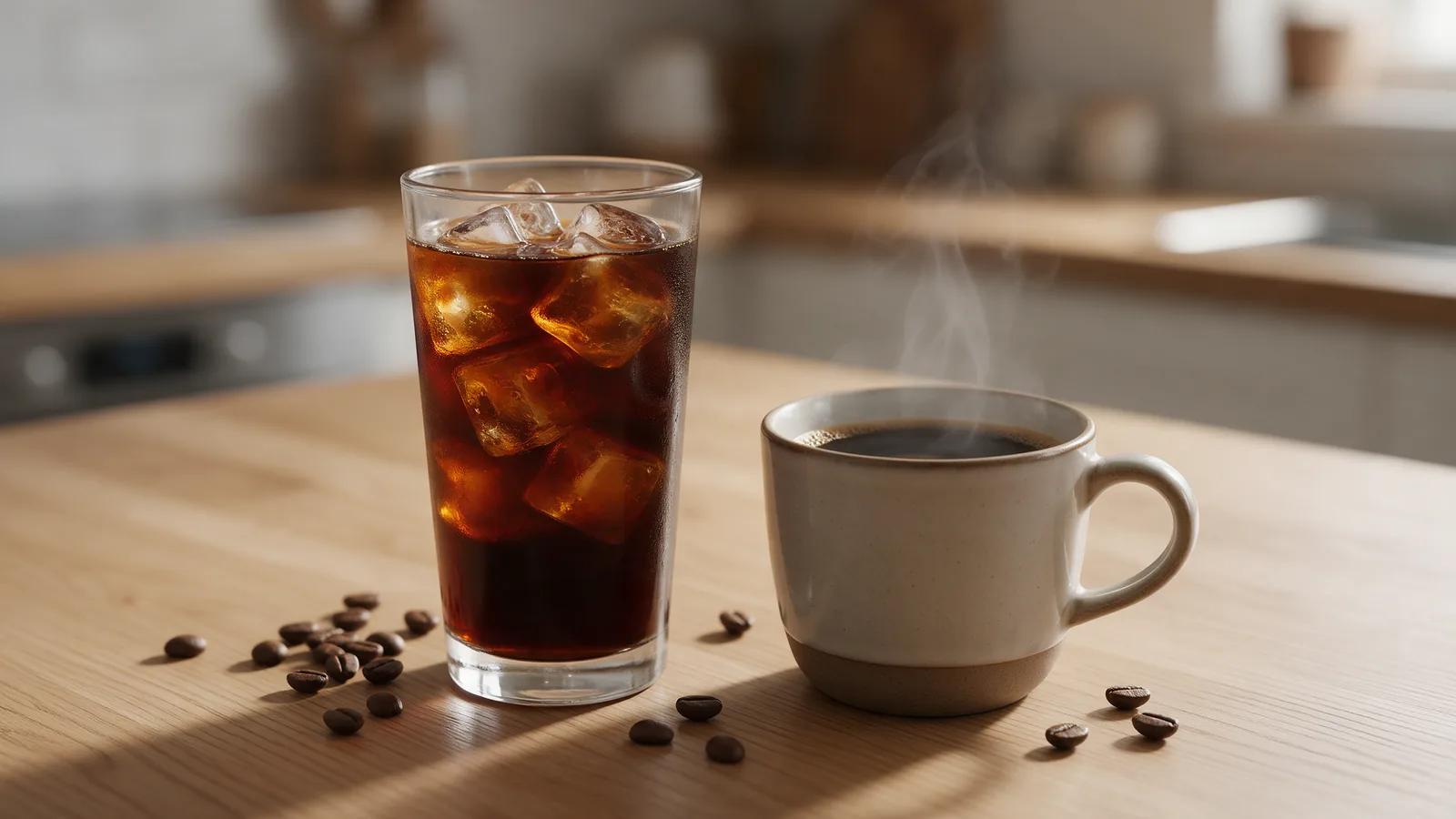
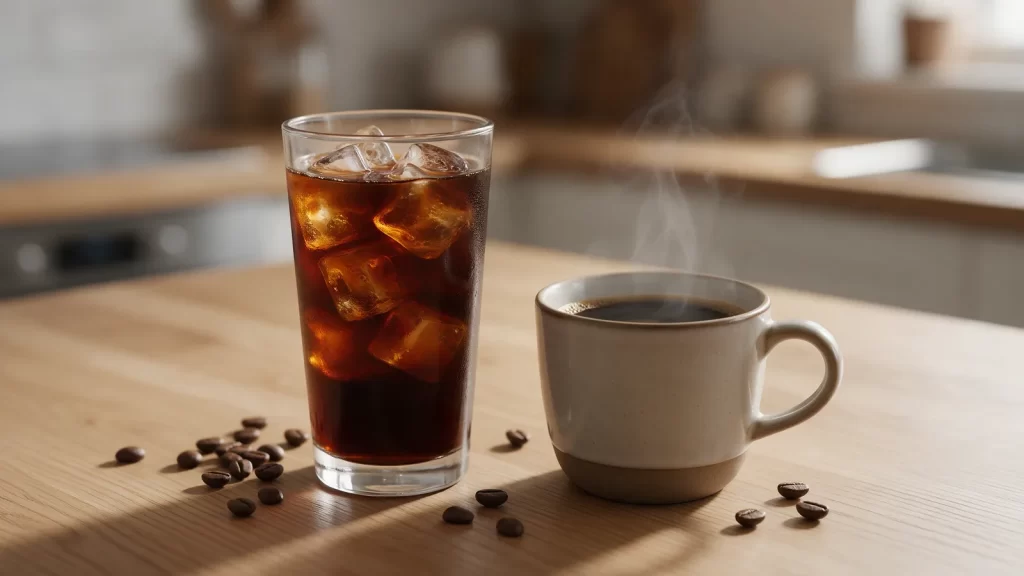
Does cold brew have more caffeine than regular coffee? Usually yes, but not because cold water extracts more. Cold brew is brewed with more coffee per litre and served in bigger glasses, so a typical 12 oz (355 ml) glass carries about 150 to 250 mg of caffeine, against roughly 140 mg in a 12 oz mug of hot drip coffee. Per millilitre, ready-to-drink cold brew and hot coffee are often close, espresso is far stronger, and an undiluted cold brew concentrate sits in between. How much caffeine is in cold brew in your glass comes down to three things: the coffee-to-water ratio, how much you dilute it and the size of the serving.
Short answer: how much caffeine is in cold brew (mg per cup)
There is no single official figure for cold brew, because every café and home recipe uses a different ratio. These are realistic ranges, built from USDA data for hot coffee and espresso, published chain nutrition information and the strength of standard cold brew recipes:
- Home cold brew, ready to drink (1:8), 8 oz / 240 ml: about 100–180 mg.
- Cold brew concentrate (1:4 to 1:5), 2 oz / 60 ml undiluted: about 60–100 mg.
- Concentrate diluted 1:1, 12 oz glass with ice: about 120–200 mg.
- Starbucks Cold Brew, grande 16 oz: about 205 mg (tall 155 mg, venti 310 mg).
- Hot drip coffee, 8 oz: about 95 mg (USDA), with a normal range of 80–140 mg.
- Espresso, single 1 oz / 30 ml shot: about 63 mg.
So cup for cup, cold brew usually comes out ahead of hot coffee, and well ahead of a single espresso. For the full list of drinks and sizes, see our guide to how much caffeine is in coffee.
Why cold brew caffeine varies so much: ratio, dilution and steep time
A 12 oz glass of cold brew can hold 100 mg or almost 300 mg. The difference is not mysterious, and once you know the three levers you can set your own dose.
The ratio decides almost everything
Hot drip coffee is brewed at about 1:15 to 1:17 (60–65 g of coffee per litre of water). Ready-to-drink cold brew is usually brewed at 1:8 to 1:10, and concentrate at 1:4 to 1:5, which is three to four times more coffee per litre than drip. More grounds in the water means more caffeine in every millilitre. Our cold brew ratio guide has the grams for each batch size.
Dilution brings it back down
A concentrate is never meant to be drunk neat. Diluting it 1:1 with water or milk halves the caffeine per millilitre, 1:2 cuts it to a third, and melting ice adds another 15–25% of water as you drink. Two people can start from the same jar and end up with glasses that differ by 100 mg, just from how they pour. The cold brew concentrate recipe explains how to dilute for a bold or mild glass.
Steep time matters less than you think
Caffeine dissolves well in water at any temperature, it just does so more slowly in cold water. In a 2017 study in Scientific Reports, Niny Rao and Megan Fuller at Thomas Jefferson University measured cold brew over time and found that caffeine concentration levelled off after about 6 to 7 hours. Steeping 12, 18 or 24 hours mainly changes flavour, not caffeine. The same researchers found that a cold brew and a hot brew made at the same ratio end up with broadly similar caffeine levels. In other words, cold brew is strong because of the recipe, not because of the cold.
The bean and the cup size
Robusta beans contain about 2.2–2.7% caffeine, versus 1.0–1.5% for Arabica, so a cold brew blend with Robusta can nearly double the caffeine. Roast level barely changes it. And the serving size does the rest: a venti iced cold brew at 24 oz holds far more than a 4 oz espresso cup, whatever is in it. If you want the details on beans, see Arabica vs Robusta.
Cold brew vs drip coffee vs espresso: caffeine compared
This table compares a typical serving of each drink and, more usefully, its caffeine per millilitre. Figures are averages; home recipes can move them 30% either way.
| Drink | Serving | Caffeine (mg) | Approx. mg per ml |
|---|---|---|---|
| Espresso, single | 1 oz / 30 ml | 63 | 2.1 |
| Espresso, double | 2 oz / 60 ml | 125 | 2.1 |
| Cold brew concentrate (1:4–1:5), undiluted | 2 oz / 60 ml | 60–100 | 1.0–1.7 |
| Cold brew, ready to drink (1:8) | 8 oz / 240 ml | 100–180 | 0.4–0.75 |
| Concentrate diluted 1:1, over ice | 12 oz glass | 120–200 | 0.5–0.8 |
| Hot drip coffee | 8 oz / 240 ml | 95 | 0.4 |
| Hot drip coffee | 12 oz / 355 ml | 140 | 0.4 |
| Starbucks Cold Brew | Grande, 16 oz | 205 | about 0.43* |
| Starbucks Nitro Cold Brew | Grande, 16 oz | 265 | about 0.55 |
| Starbucks Pike Place (hot) | Grande, 16 oz | 310 | 0.65 |
*The Starbucks iced drink includes ice, so the coffee itself is somewhat stronger than the per-cup average suggests.
Two things stand out. First, espresso is by far the most concentrated, but it is served in tiny amounts, which is why a single shot has less caffeine than almost any cold brew. Our article on espresso vs coffee goes deeper into that trade-off. Second, at Starbucks the hot brewed coffee actually beats the cold brew in the same size, because the chain brews its hot coffee strong and serves cold brew over ice.
How to make cold brew with less caffeine
If you love the smooth, low-acid taste but not the jitters, you do not have to give it up. Each of these changes works on its own, and together they can bring a glass down to 60–80 mg:
- Brew ready to drink at 1:8 to 1:10 instead of a 1:4 concentrate, and skip guesswork with dilution.
- Dilute concentrate 1:2 or 1:3 with water or milk, not 1:1.
- Pour a smaller glass: 8 oz (240 ml) instead of 16 oz halves the dose.
- Go half-caf: mix 50% regular and 50% decaf beans before grinding. Decaf has only 2–15 mg per cup.
- Use 100% Arabica and avoid blends labelled “high caffeine”, which usually contain Robusta.
A shorter steep is not a good way to lower caffeine: as the research above shows, most of it is already in the water by hour seven, so cutting the steep mostly makes the coffee sour. Here is a gentle everyday recipe:
Low-caffeine cold brew (half-caf, ready to drink)
- Coffee
- 100 g: 50 g regular + 50 g decaf, medium roast
- Water
- 1,000 g (1 L) filtered water
- Grind
- Coarse (French press)
- Water temp
- Fridge, 4 °C
- Time
- 16–20 h
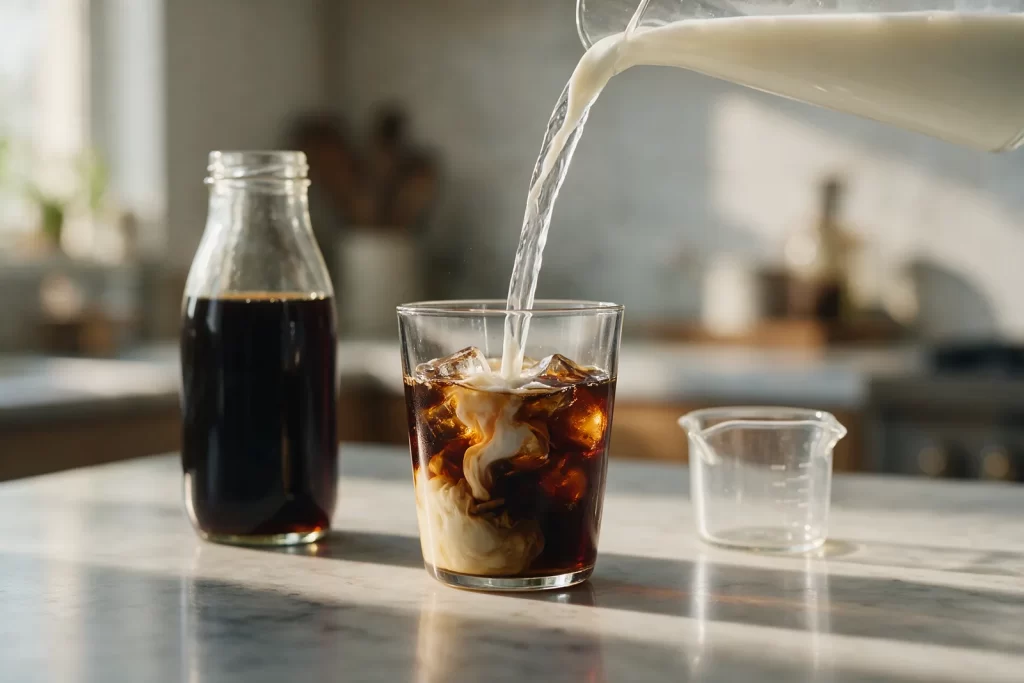
Served as an 8 oz glass over ice, this lands around 50–70 mg of caffeine, less than a single espresso, with all the chocolatey smoothness of regular cold brew.
FAQ
Is cold brew stronger than espresso?
Per millilitre, no. Espresso has about 2 mg of caffeine per ml, while a cold brew concentrate has roughly 1–1.7 mg and ready-to-drink cold brew under 1 mg. Per serving, yes: a 12 oz glass of cold brew (150–250 mg) usually has more caffeine than a double espresso (about 125 mg), simply because you drink much more of it.
How much caffeine is in a Starbucks cold brew?
According to Starbucks’ published nutrition information, a tall (12 oz) Cold Brew has about 155 mg of caffeine, a grande (16 oz) about 205 mg, a venti (24 oz) about 310 mg and a trenta (30 oz) about 360 mg. A grande Nitro Cold Brew has about 265 mg. Adding sweet cream or milk does not change the caffeine, only the volume.
Does cold brew keep you awake longer?
Not in itself. Caffeine from any coffee is absorbed within about 45 minutes and has an average half-life of around 4 to 5 hours in healthy adults (EFSA puts the usual range at 2 to 8 hours), whether the drink is hot or cold. Cold brew can feel longer-lasting because the glasses are bigger and people sip them slowly over an hour or two, which spreads out the dose. If you sleep badly, keep your last cold brew at least 6 hours before bed and treat a large glass as two coffees.
How much cold brew can I drink a day?
The US FDA and the European Food Safety Authority consider up to 400 mg of caffeine a day safe for most healthy adults, and EFSA advises no more than 200 mg a day during pregnancy. That is about two 12 oz glasses of a typical cold brew, or one venti from a chain. Count the concentrate you pour, not the glass size, if you make it at home.
Sources
- Fuller M, Rao NZ (2017). “The effect of time, roasting temperature, and grind size on caffeine and chlorogenic acid concentrations in cold brew coffee”. Scientific Reports 7, 17979.
- USDA FoodData Central: coffee, brewed; coffee, espresso.
- US FDA: “Spilling the Beans: How Much Caffeine Is Too Much?”.
- EFSA (2015): Scientific Opinion on the safety of caffeine.
- Starbucks published nutrition information (Cold Brew, Nitro Cold Brew, Pike Place Roast).
About the author
Keep reading
How Long Does Cold Brew Last in the Fridge? (And Can You Heat It Up?)
Cold brew concentrate lasts up to 2 weeks in the fridge, diluted 3–4 days, with milk 1–2. Signs it's gone bad, storage tips and how to heat it up.
What Is Nitro Cold Brew? Taste, Caffeine and How It’s Made
What is nitro cold brew? Cold brew charged with nitrogen and poured from a tap: creamy, no dairy, about 265 mg caffeine per 16 oz. How to make it at home.
French Press Coffee Ratio: How Much Coffee to Use (Chart)
The best French press coffee ratio is 1:15: 30 g of coarse coffee for 450 ml of water. Chart by press size, grind, steps and fixes for bitter cups.